Twenty Menu Options, One PDF, No Clue What They Want
A catering company sends its corporate menu to a new lead - an office manager at a tech company with 80 employees. The PDF has 20 pages: daily business lunch sets, banquet menus for events, coffee break packages, buffet options for team gatherings, and premium dining for executive meetings. Each page shows the format, headcount options, pricing per person, and sample menus.
The office manager says "thanks, we'll review it internally" and goes quiet for a week.
The sales manager has no idea what the client needs. Is it daily lunches for the whole office? A one-time holiday party? Coffee service for a board meeting? Without knowing the format, headcount, or budget, the follow-up call becomes a fishing expedition: "So, what were you thinking?" That question puts the work back on the client - and most clients will not do your job for you.
Office managers who handle catering compare three to five vendors simultaneously. The first vendor to send a relevant proposal - not a generic one - wins the conversation.
How It Can Work: Page 8 Tells the Story
The same sales manager uploads the menu catalog to PaperLink and sends a tracked link. The office manager opens it in the browser - no download, no login required.
Over six days, PaperLink records every interaction:
| Page | Menu section | Views | Total time | Pattern |
|---|---|---|---|---|
| 1 | Company overview | 1 | 15 sec | Glanced |
| 2 | How it works (ordering process) | 1 | 20 sec | Glanced |
| 3 | Daily lunch - 10 persons | 2 | 40 sec | Some interest |
| 4 | Daily lunch - 15 persons | 2 | 35 sec | Some interest |
| 5 | Daily lunch - 25 persons | 1 | 25 sec | Glanced |
| 6 | Daily lunch - 50 persons | 1 | 8 sec | Skipped |
| 7 | Daily lunch - 100 persons | 1 | 5 sec | Skipped |
| 8 | Daily lunch - 25 persons (vegetarian + standard) | 4 | 3 min 50 sec | Kept returning |
| 9 | Coffee break - standard | 2 | 30 sec | Minor interest |
| 10 | Coffee break - premium | 1 | 10 sec | Skipped |
| 11 | Buffet - 30 persons | 1 | 12 sec | Skipped |
| 12 | Buffet - 50 persons | 1 | 6 sec | Skipped |
| 13 | Buffet - 100 persons | 1 | 4 sec | Skipped |
| 14 | Banquet set - standard | 1 | 8 sec | Skipped |
| 15 | Banquet set - premium | 1 | 5 sec | Skipped |
| 16 | Executive dining | 1 | 10 sec | Skipped |
| 17 | Holiday party packages | 1 | 7 sec | Skipped |
| 18 | Dietary options overview | 3 | 1 min 20 sec | Moderate interest |
| 19 | Delivery logistics | 2 | 45 sec | Some interest |
| 20 | Pricing summary | 3 | 1 min 10 sec | Moderate interest |
Four signals emerge from this data.
Format preference: daily lunches. The client spent nearly all their time on daily lunch pages (pages 3-8) and skipped every event catering option - buffets, banquets, holiday packages, executive dining. All viewed for under 12 seconds. The need is operational, not event-based.
Headcount: around 25 people. Page 8 - daily lunches for 25 persons with vegetarian and standard options - was visited four times across three sessions, with nearly four minutes of viewing time. Pages for 50 and 100 persons were dismissed instantly. The client is not feeding the entire 80-person office. They are feeding a specific team or floor.
Dietary requirements matter. Page 18 (dietary options overview) received three visits and over a minute of reading time. Combined with the focus on page 8 (the menu that includes vegetarian options), the client has team members with dietary needs and wants to confirm coverage.
This is an ongoing need, not a one-time order. The client returned to the catalog six times over six days, revisiting the daily lunch and logistics pages. A one-time event order produces a single viewing session. Multiple sessions spread over a week indicate the client is evaluating an ongoing service contract.
From Data to a Winning Proposal
The sales manager calls on Monday morning:
"Hi, I wanted to follow up on the menu we sent. It sounds like your team might be looking for daily lunch service for around 25 people, with vegetarian options included. I have put together a quick calculation - 25 persons, five days a week, with a mixed menu that covers standard and vegetarian. The per-person rate drops to 12 EUR at a monthly commitment. Would it be useful to walk through the numbers?"
Compare this to: "Hi, just following up on the menu we sent. Did you have any questions? We can do daily lunches, events, coffee breaks - whatever you need."
The first call saves the office manager 20 minutes of explaining what they need. The second asks the client to do the vendor's thinking. Office managers juggling five vendor conversations will prioritize the one who already understands the brief.
Send separate tracked links to different contacts at the same company. If the office manager focuses on daily lunches while the HR manager revisits the team-building event pages, you know there are two separate needs - and two potential contracts.
Five Signals That Predict Catering Decisions
1. Format tells you the relationship type. Daily lunch viewers are looking for a vendor partner - recurring revenue, predictable orders, long-term contracts. Event catering viewers need a one-time service provider. The sales conversation, pricing strategy, and proposal structure are completely different for each.
2. Headcount pages reveal team size. A client who spends three minutes on the 25-person page and skips the 100-person page is not understating their needs to negotiate. They know their number. Build the proposal around that headcount, not a range.
3. Dietary page engagement signals complexity. When a client returns to dietary options multiple times, their team has specific needs - vegetarian, halal, gluten-free, allergen management. Addressing this in the first proposal demonstrates operational readiness. Ignoring it guarantees a follow-up question that delays the deal.
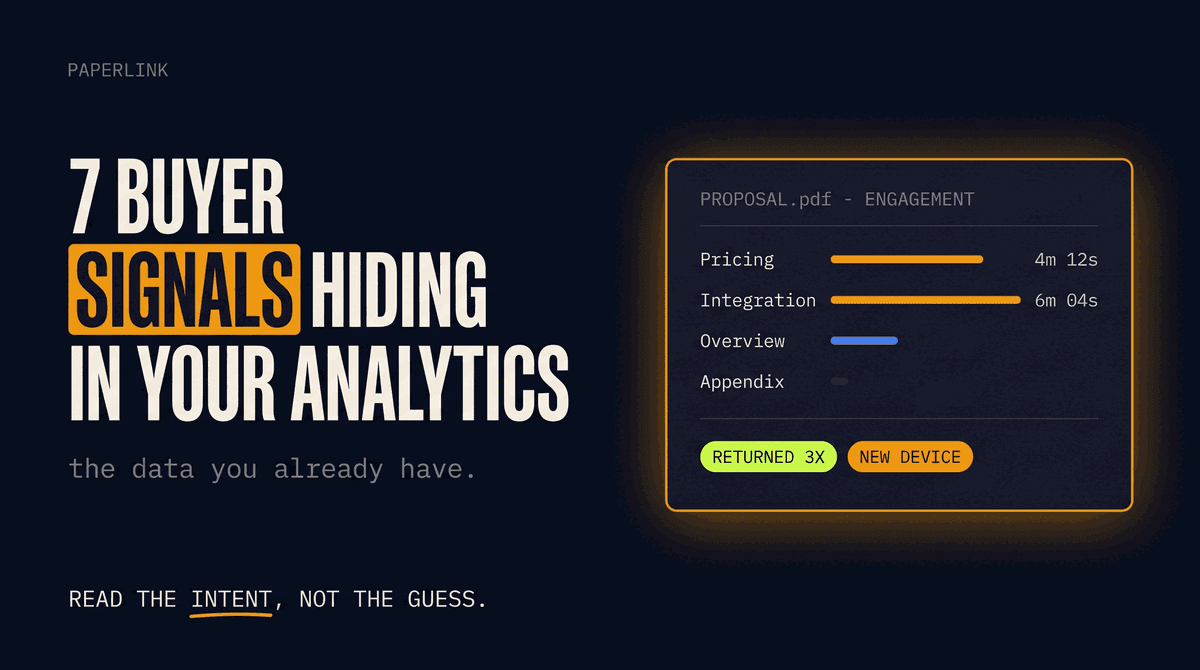
4. Pricing page return visits mean budget comparison. Three visits to the pricing summary means the client is comparing your numbers against other vendors. If they also revisit a specific menu page after viewing pricing, they are checking whether the cost matches the value. Prepare a competitive comparison or volume discount to address this in the call.
5. Logistics page attention signals operational concern. Time on delivery logistics - cutoff times, packaging, temperature control, delivery windows - means the client has been burned before or has strict requirements. Lead the follow-up with your logistics capabilities, not your menu variety.
Why Speed and Specificity Win Catering Contracts
Corporate catering operates on thin margins and high volume. A daily lunch contract for 25 people at five days a week generates 500 meals per month. A 12-month contract means 6,000 meals - meaningful revenue from a single client.
But office managers do not run formal RFPs for catering. They send emails to three to five vendors, review menus, and go with whoever makes the decision easiest. The selection process takes days, not weeks. A vendor who responds with a tailored proposal within 48 hours of sending the menu - addressing the right format, the right headcount, and the right dietary needs - shortens the decision to a single conversation.
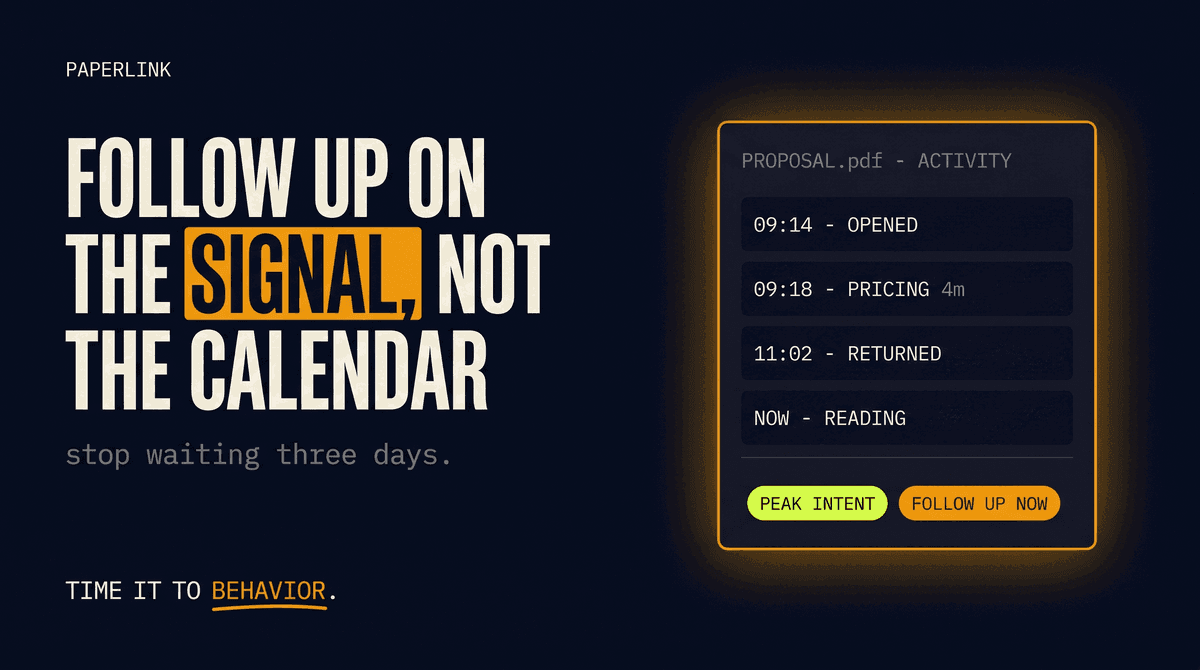
Document analytics compress the discovery phase. Without analytics, the sales process is: send menu, wait for response, ask what they need, send revised proposal, negotiate. With analytics, the process becomes: send menu, read behavior, send tailored proposal. Three steps instead of five.
PaperLink records page-level viewing analytics - including time per page, return visits, and session frequency - for every shared document. Analytics are available on the free plan.
How to Set This Up for Your Catering Business
The workflow takes less than five minutes:
-
Structure your menu as a multi-page PDF. One page per service format and headcount tier. "Daily lunch - 25 persons" gets its own page, separate from "Daily lunch - 50 persons." The more granular the pages, the more specific the analytics.
-
Upload to PaperLink. See Upload Documents for the upload flow.
-
Enable email verification. The client enters their email before viewing. Every page view is tied to their identity - you know that the office manager, not their intern, spent four minutes on the 25-person daily lunch page.
-
Send one link per prospect. Each company gets a unique tracked link. Analytics stay separate across prospects. You see that Company A wants daily lunches for 25 while Company B is exploring event buffets - from the same catalog.
-
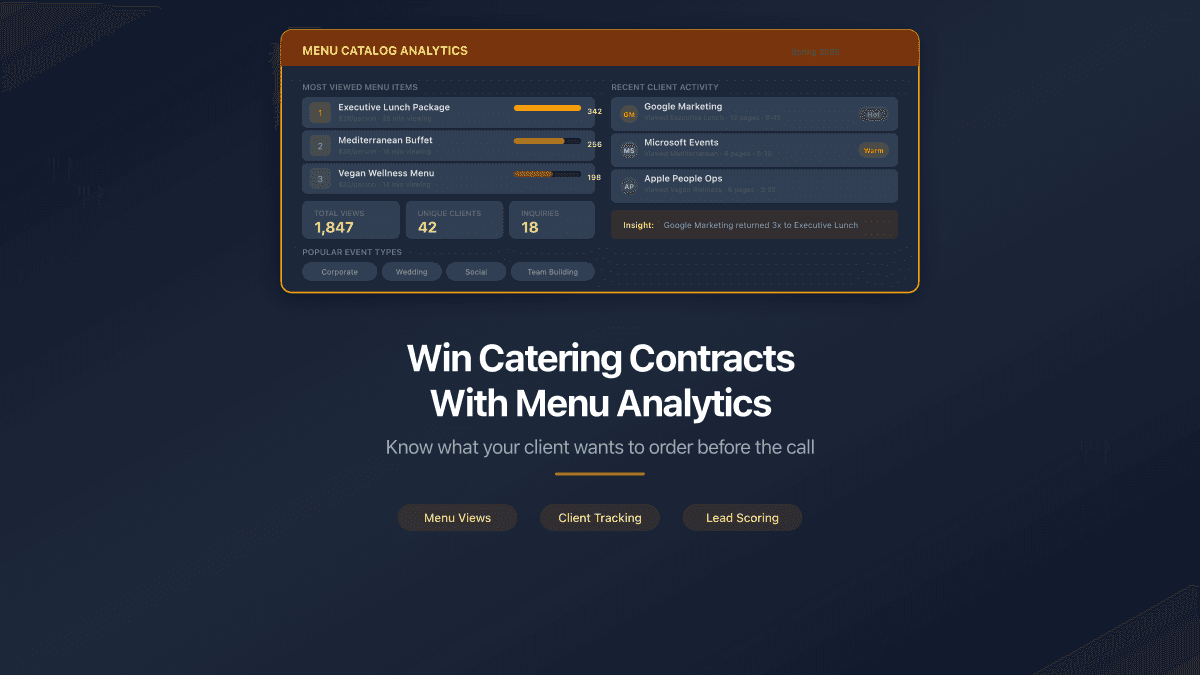
Check analytics before every follow-up. The analytics dashboard shows page-by-page engagement for every viewer. Identify the high-interest pages and build your proposal around them.
The Vendor Who Understands the Brief First, Wins
Every catering company sends a menu. The one that follows up with a specific proposal - right format, right headcount, right dietary options, right price point - wins the contract. Page-level analytics turn a generic follow-up into a prepared conversation.
Upload your menu catalog, send a tracked link, and know what your client wants before they tell you.
Share your first tracked document. For the full analytics breakdown, see Track Who Viewed Your Shared Documents. For other industry use cases, see Real Estate Agent Analytics and Commercial Leasing Analytics. For proposal tracking, see How to Send a Business Proposal That Gets Read.