A professor shares a student's grade with a parent without checking whether the student consented to the disclosure. The dean's office investigates. The professor's defense: "I didn't know that was a FERPA violation." The institution's defense: "We distributed the training." The Department of Education's question: "Can you prove the professor read it?"
Educational institutions distribute more compliance-sensitive documents than most organizations realize. FERPA training for staff. Title IX policies for employees and students. Student codes of conduct. Acceptable use policies for campus networks. Safety procedures. Research integrity guidelines. Each carries legal obligations and institutional liability.
The standard approach - email a PDF, collect a signed acknowledgement form, file it - proves distribution. It does not prove reading. When a compliance investigation begins, that distinction determines whether the institution demonstrates due diligence or exposes a documentation gap.
What FERPA Requires from Training Documentation
The Family Educational Rights and Privacy Act protects student education records and gives parents (and eligible students) rights over those records. Every institution receiving federal funding must comply - which means virtually every school, college, and university in the United States.
FERPA does not prescribe a specific training format. But the Department of Education expects institutions to conduct frequent FERPA training for staff and faculty who handle student records and to track and document training participation.
The practical requirements are clear:
Timing. All faculty and teaching assistants must complete FERPA training within their first month of employment. This is not a suggestion - it is the standard enforcement agencies reference.
Frequency. Mandatory FERPA training should be conducted every three years at minimum, with refreshers when policies change or when a staff member violates FERPA.
Role-based content. Training should be differentiated by role: teachers need to understand classroom data rules, administrators need proper disclosure procedures, IT staff need technical controls for access management and audit logging.
Documentation. Certificates of completion must be uploaded and retained as proof of compliance. This is the evidence the Department of Education requests during an investigation.
The penalty for non-compliance is severe. Institutions can lose federal funding - the most significant enforcement mechanism in education. Individual violations trigger remediation costs averaging $8,500 per incident, with total costs averaging 2.3 times the initial penalty when accounting for training programs, system updates, and administrative overhead.
FERPA violations are investigated by the Department of Education's Student Privacy Policy Office. Regular compliance reviews - including documented training evidence - have been shown to reduce penalty amounts by nearly half. Institutions that cannot produce training records face the full weight of enforcement.
Title IX: When Acknowledgement Becomes Mandatory
Title IX compliance adds another layer of policy documentation. Every employee at a school receiving federal funds has obligations under Title IX - reporting requirements, non-retaliation policies, and conduct standards that vary by role.
Schools should consider requiring employees to acknowledge in writing that the Title IX reporting obligation was explained to them and they understand the school may impose discipline for failing to report. This is not optional guidance for institutions that want to defend their compliance posture - it is the standard that investigators reference.
The documentation challenge: compliance is not a one-time project. With Title IX regulations evolving and new guidance expected in 2026, institutions must demonstrate that employees understood the current policy at the time of any incident. A signed form from two years ago proving acknowledgement of the previous policy version does not satisfy this requirement.
For student-facing policies - codes of conduct, residence hall agreements, academic integrity policies - institutions face a parallel challenge. Students acknowledge the handbook during orientation. Months later, when a conduct violation occurs, the student claims they were not aware of the specific rule. The institution's evidence is a checkbox from the first week of the semester.
Why Signed Acknowledgement Forms Fall Short
Educational institutions rely on three documentation methods, each with structural limitations:
Orientation sign-off sheets. Students sign during a week of overwhelming information overload. Staff sign during onboarding alongside dozens of other forms. The signature proves the document was physically present. It does not prove anyone opened the 80-page student handbook or the 25-page FERPA training manual.
LMS completion records. Many institutions deliver compliance training through their learning management system. The LMS records "completed" when the employee finishes the module. But LMS modules can be clicked through in minutes - and many are, especially during busy periods when faculty treat compliance training as an administrative obstacle.
Email distribution with read receipts. The policy is attached to an email. A read receipt confirms the email was opened. It says nothing about whether the attachment was downloaded, let alone read. For a 40-page Title IX policy, an email receipt is evidence of delivery, not engagement.
These methods satisfy the minimum interpretation of "documented training." They do not satisfy the spirit of what investigators look for: evidence that the person understood their obligations.
What Effective Education Compliance Evidence Looks Like
Institutions need documentation that answers the investigator's question: "Did this person read and engage with the policy?"
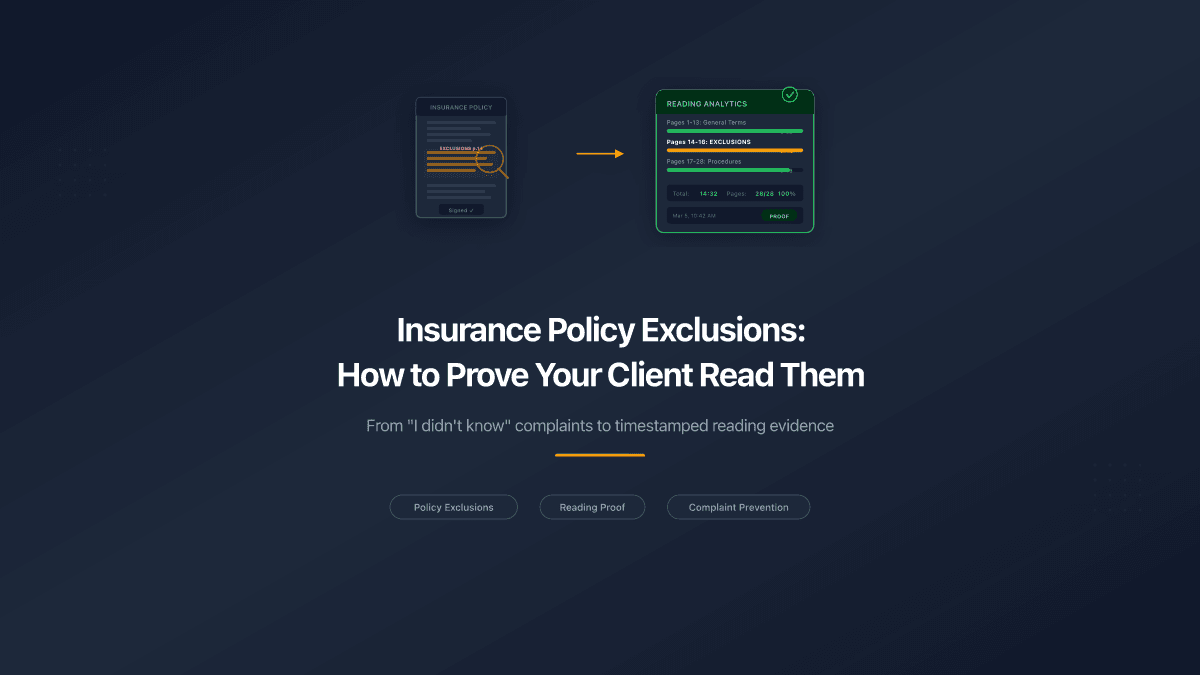
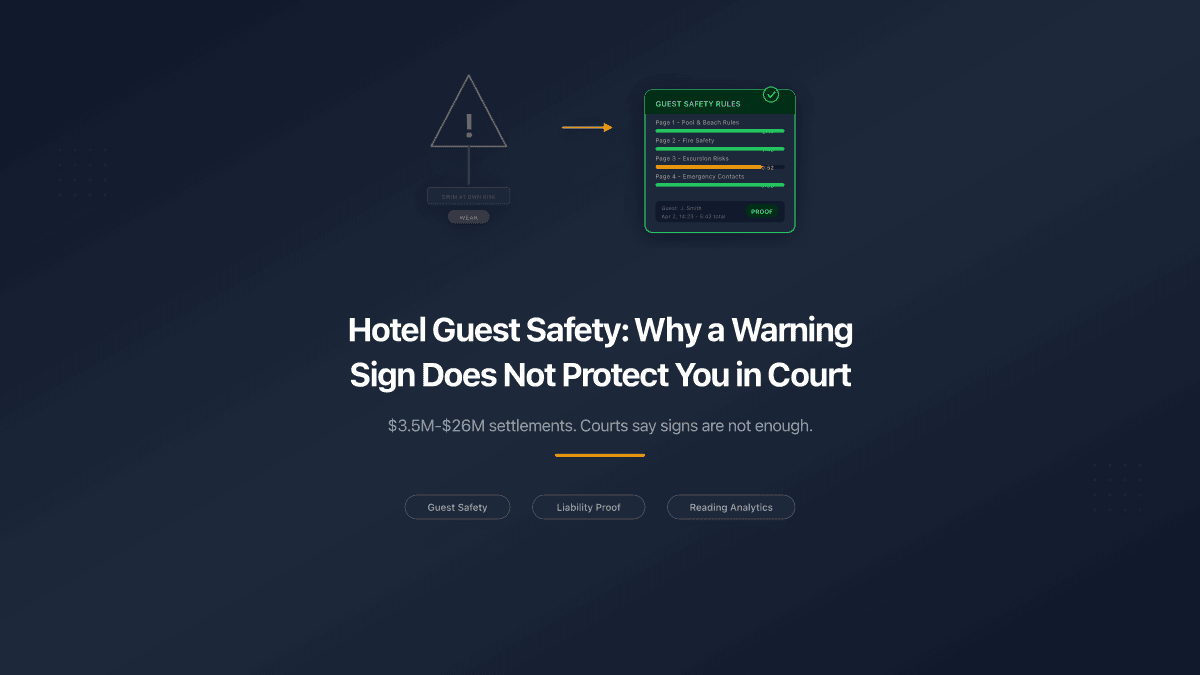
Page-level reading data. When a faculty member completes FERPA training, page-level analytics show how long they spent on each section. An 18-page training document read for 12 minutes with consistent time per page indicates genuine engagement. The same document "completed" in 45 seconds does not.
Role-differentiated distribution records. FERPA requires role-based training. Evidence should show that teachers received classroom-specific data handling guidance while registrar staff received records disclosure procedures. A single "FERPA training completed" entry does not demonstrate role-appropriate education.
Onboarding window verification. With a one-month FERPA training deadline for new hires, reading analytics with timestamps prove exactly when the new employee engaged with the material - not just when the LMS recorded completion.
Version-controlled acknowledgement. When Title IX policies update, the institution needs evidence showing which employees read the new version. A generic "acknowledged" flag does not distinguish between an employee who read the 2024 policy and one who read the 2026 update.
Student handbook engagement tracking. Instead of "4,200 students acknowledged the student handbook during orientation," the compliance office can see: "3,800 students opened the handbook. Average reading time: 14 minutes. 400 students did not open the document. Sections with lowest engagement: academic integrity (page 34) and conduct hearing procedures (page 52)."
| Document | Traditional Evidence | Reading Analytics |
|---|---|---|
| FERPA training | "Completed module" | "Read all 18 pages, 14 min, focused on disclosure rules" |
| Title IX policy | "Signed acknowledgement" | "Viewed all sections, returned to reporting obligations twice" |
| Student handbook | "Checked box at orientation" | "Opened handbook, read 42 of 80 pages, 22 min over 3 sessions" |
| Code of conduct | "Orientation attendance" | "Viewed academic integrity section (pages 28-35), 6 min" |
| Acceptable use policy | "Signed form" | "Read all 8 pages, 5 min, completed within first week" |
Who Needs This in Education
Policy compliance documentation touches every role in an educational institution:
| Role | Key Documents | Why Reading Proof Matters |
|---|---|---|
| Faculty | FERPA training, academic integrity policies, Title IX reporting | Must prove they understood student data rules before handling records |
| Administrators | FERPA disclosure procedures, records management policies | Handle records requests - mistakes trigger federal investigations |
| IT staff | FERPA technical controls, data security policies | Configure access to student information systems |
| Title IX coordinators | Title IX procedures, investigation protocols | Must demonstrate their team is current on evolving regulations |
| Students | Handbook, code of conduct, residence agreements | Institution needs evidence students were informed of rules before violations |
| Parents | FERPA rights notification, directory information opt-out | Annual notification is a FERPA requirement - delivery must be documented |
FERPA requires institutions to provide annual notification to parents and eligible students of their rights under FERPA. This notification must be distributed through a method "reasonably likely to inform" them. Reading analytics on a shared notification document provide evidence that the notification reached its audience - not just that it was posted on a website.
The International Dimension
FERPA is US-specific, but educational data protection requirements exist globally:
- GDPR (EU) applies to universities processing student data from EU residents. Staff training on data handling is required with documented evidence.
- PDPA (Singapore) requires educational institutions to train staff on personal data protection obligations.
- Australia's Privacy Act applies to universities and requires documented privacy training for staff handling student records.
- UK GDPR post-Brexit maintains similar requirements for UK educational institutions.
International schools and universities with cross-border student populations face overlapping requirements. A university in Singapore with EU exchange students must satisfy both PDPA and GDPR training documentation standards. The evidence challenge is the same: prove your staff read and understood the policy, not that they signed a form.
How This Works for Schools and Universities
The workflow fits into existing institutional processes:
- Upload the compliance document - FERPA training manual, Title IX policy, student handbook, code of conduct - to a document sharing platform with reading analytics
- Generate tracked links per role group (faculty, staff, students), per department, or per individual
- Distribute through existing channels - the LMS as a supplementary link, campus email, the student portal, or orientation materials
- Recipients click the link and read in a browser-based viewer on any device - laptop, tablet, or phone. No app needed
- The analytics engine records every session: pages viewed, time per page, completion percentage, return visits
- The compliance office accesses a dashboard showing institution-wide completion rates, flags for low engagement, and exportable reports for investigations
For student handbook distribution, the same approach works at scale. Send 5,000 students a tracked link during orientation week. The compliance office sees real-time completion data instead of waiting for signed forms to trickle in over weeks.
From Compliance Checkbox to Genuine Awareness
Educational institutions invest significant effort in creating compliance training materials, writing comprehensive handbooks, and developing policies that protect students and staff. The weak link is not the content - it is the evidence that the content reached its audience.
When a FERPA investigation asks whether a staff member understood disclosure rules, the answer should be data showing they spent 14 minutes reading the procedures - not a checkbox from onboarding. When a Title IX inquiry examines whether an employee knew their reporting obligation, the evidence should include per-page reading analytics showing they reviewed the reporting section specifically.
The signed form had its era. Reading analytics prove what the signature cannot: that the person behind the name engaged with the words on the page.
The same reading-evidence approach applies to corporate security audits - see How Reading Analytics Strengthen SOC 2 Policy Acknowledgement.
PaperLink tracks page-by-page viewing analytics for shared documents - including time per page, completion percentage, and tab visibility detection. Educational institutions use it to distribute FERPA training, Title IX policies, and student handbooks with audit-ready reading evidence. Try it free.