OCR investigators have a phrase that should concern every healthcare compliance officer: "Training that is not documented is indistinguishable from training that never happened." Your HIPAA training program may be thorough. Your policies may be current. But if your documentation shows nothing beyond attendance signatures and completion checkboxes, you have a six-figure problem waiting to surface.
The HIPAA Security Rule under 45 CFR 164.308(a)(5) requires covered entities and business associates to implement a security awareness and training program for all members of their workforce - including management. The Privacy Rule under 45 CFR 164.530(b) requires training on policies and procedures for handling protected health information. Both require documentation. Neither specifies what that documentation should look like.
That ambiguity is where most organizations fail.
What OCR Actually Looks For
When the Office for Civil Rights investigates a breach or complaint, training documentation is among the first items requested. The documentation retention requirement is six years - longer than most organizations maintain their learning management system records.
OCR does not check whether your staff attended a webinar. They check whether your organization can demonstrate that workforce members understood the policies relevant to their role. The distinction matters. An attendance record proves someone was present. It does not prove they read the incident response procedure, understood the minimum necessary standard, or knew how to report a suspected breach.
Recent enforcement actions make the stakes concrete. Premera Blue Cross settled with OCR for $6.85 million, with inadequate workforce training explicitly cited. Inadequate training documentation is a consistent factor in OCR settlements, appearing alongside technical failures and policy gaps as evidence of systemic non-compliance.
The penalty structure scales with culpability. Unknowing violations start at $100 per incident. Willful neglect without correction reaches $50,000 per violation per day with no annual cap. When a single breach can involve thousands of records, each representing a separate violation, the arithmetic is severe.
The 2026 Security Rule Shift
The proposed 2026 HIPAA Security Rule amendments signal where enforcement is heading. Training requirements are shifting from "addressable" to "mandatory" - organizations can no longer treat annual security awareness training as optional based on a risk assessment.
More significant is the emphasis on competency verification. The proposed updates push toward documented competency assessments rather than attendance records. This means proving that workforce members understood the material - not that they sat through it.
For compliance officers, this changes the evidence standard. A learning management system that tracks "completed" versus "not completed" meets the old standard. The new standard asks: how do you know they completed it with comprehension?
The 2026 Security Rule amendments also introduce mandatory encryption for all ePHI and multi-factor authentication for all systems accessing patient data. Training documentation must show that workforce members understand these new requirements - not just the legacy policies.
Why Attendance Records Fall Short
Most healthcare organizations document HIPAA training through one of three methods: sign-in sheets from live sessions, completion records from an LMS, or signed acknowledgement forms for policy documents. All three prove the same thing - that the employee's name appeared in a system. None prove reading.
Sign-in sheets prove presence, not attention. A nurse who signs into a 30-minute HIPAA refresher while answering pages and checking patient charts is documented as "trained." OCR cannot distinguish this from a nurse who listened carefully.
LMS completion records prove clicks, not comprehension. A 45-minute e-learning module "completed" in 8 minutes - because the employee clicked through every screen without reading - shows as 100% complete. The LMS records achievement. It does not record engagement.
Acknowledgement signatures prove receipt, not reading. The annual policy acknowledgement form confirms the employee received the updated privacy practices document. It does not confirm they opened it, let alone read its 30 pages.
These documentation methods satisfied regulators for years. The shift toward competency assessments in the 2026 amendments reflects what OCR investigators already know: completion does not equal comprehension.
What Genuine Training Evidence Looks Like
Healthcare organizations need documentation that answers the question OCR actually asks: "Did your workforce understand the policies that protect patient data?"
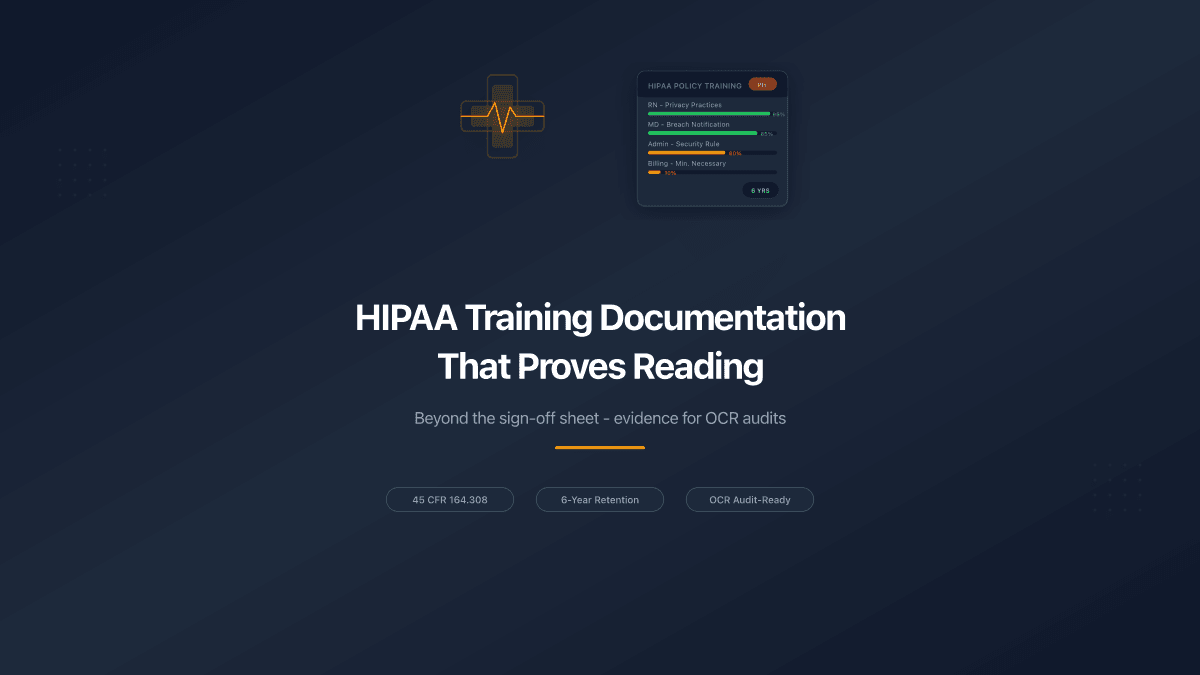
Page-level time tracking. When a compliance officer distributes the updated breach notification procedure, page-level analytics show how long each staff member spent on each page. A 15-page policy reviewed for 12 minutes with consistent time per page indicates genuine reading. The same policy "completed" in 20 seconds does not.
Completion percentage with scroll depth. Did the workforce member view every page, or did they open the document and skip to the acknowledgement button? Scroll depth tracking distinguishes staff who read the entire privacy practices update from those who jumped to the signature page.
Tab visibility detection. When the document is open but the browser tab is not active - the workforce member switched to the EHR, email, or another application - the reading timer pauses. This prevents the pattern where staff open training materials, minimize the window, and return 30 minutes later to click "complete."
Session history. Real reading often happens across multiple sessions. A medical assistant opens the HIPAA Security Rule summary Monday morning, reads five pages, then returns Thursday to finish. Both sessions are recorded. The compliance officer sees the full engagement trajectory.
Role-appropriate evidence. A physician's reading record for the minimum necessary standard looks different from a billing clerk's reading record for the same policy. Analytics that track which role received which version of which document satisfy the Security Rule's requirement for training "commensurate with the remit of their functions."
The output for OCR: instead of "workforce training completed - see attached sign-in sheet," the compliance officer can produce a report showing each workforce member's reading engagement with each policy document, including time spent, pages viewed, completion percentage, and the specific document version.
The Documentation Standard for Each HIPAA Training Area
HIPAA training spans multiple domains, each with distinct documentation expectations:
| Training Area | Regulatory Basis | What OCR Checks | What Reading Analytics Add |
|---|---|---|---|
| Privacy practices | 45 CFR 164.530(b) | Policy distributed, acknowledgement signed | Per-page engagement with the actual policy document |
| Security awareness | 45 CFR 164.308(a)(5) | Training program exists, records maintained | Evidence that each of 4 security topics was read, not just assigned |
| Breach notification | 45 CFR 164.530(b)(1) | Workforce knows reporting procedures | Reading analytics for the breach response procedure specifically |
| New workforce onboarding | 45 CFR 164.530(b)(1) | Training within reasonable period of joining | Onboarding document completion timeline with per-document engagement |
| Material policy changes | 45 CFR 164.530(b)(2)(i) | Re-training within reasonable period of change | Version-specific reading records showing who read the updated policy |
The six-year retention requirement applies to all training documentation. Organizations that capture page-level reading data create a richer evidence trail than those relying on binary completion flags - and that trail persists for the full retention period.
HIPAA training requirements apply to the full workforce - not just clinical staff. This includes employees, volunteers, trainees, and anyone whose conduct is under the organization's direct control. Temporary staff and contractors operating under your supervision are included.
How This Works in Healthcare Settings
The workflow integrates with existing training processes rather than replacing them:
- The compliance team uploads the policy document - privacy practices, security procedures, breach notification protocol - to a document sharing platform with built-in reading analytics
- Tracked links are generated per department, per role, or per individual
- Links are distributed through the existing channel - email, the organization's intranet, the LMS as a supplementary resource, or a direct message
- Workforce members click the link and read in a secure browser-based viewer on any device - workstation, tablet, or phone. No app download, no separate login
- The analytics engine records every viewing session: pages viewed, time per page, completion, return visits
- The compliance officer accesses a dashboard showing workforce-wide completion rates, flags for low engagement, and exportable reports for OCR documentation
Live training sessions continue as before. The reading analytics layer captures what happens afterward - whether the workforce member reviewed the reference material that supports the training.
Preparing for the Competency Standard
The 2026 Security Rule amendments push healthcare organizations toward demonstrating competency, not attendance. Reading analytics contribute to this shift in three ways:
Baseline evidence of engagement. Before quizzing a workforce member on breach notification procedures, you can verify they spent meaningful time with the actual document. Low reading engagement predicts low quiz scores - and gives the compliance team a targeted remediation list.
Post-incident re-training verification. When a privacy incident occurs and the affected department undergoes re-training, reading analytics document that the re-training reached the specific individuals involved - with evidence of engagement, not just distribution.
Version-controlled audit trail. When policies are updated - as the 2026 encryption and MFA requirements will demand - the audit trail shows which workforce members read the updated version versus the old one. OCR can see exactly who is current and who needs follow-up.
The Six-Year Problem
HIPAA's six-year documentation retention requirement creates a practical challenge. Sign-in sheets degrade. LMS platforms get replaced. Email records are purged. Six years from now, when OCR requests training records from 2026, what will your organization produce?
Digital reading analytics generate structured data - exportable as PDF or CSV at any point during the retention period. The record shows who read what, when, for how long, and which version. It does not depend on a specific LMS vendor remaining in business or a filing cabinet surviving a basement flood.
The organizations that build this evidence standard now will face OCR investigations with data, not apologies. The ones that rely on attendance checkboxes will discover the documentation gap at the worst possible time.
PaperLink tracks page-by-page viewing analytics for shared documents - including time per page, completion percentage, and tab visibility detection. Healthcare organizations use it to generate HIPAA-compliant evidence of policy reading across all workforce roles. Documentation is retained and exportable for the full six-year retention period. Try it free.