A machine operator signs the lockout/tagout training sheet on Tuesday. On Thursday, they bypass the energy isolation procedure because they never read the machine-specific steps. The sign-off sheet in the EHS binder says "trained." The hospital visit says otherwise.
Manufacturing safety documentation exists to prevent this scenario. Standard operating procedures, lockout/tagout protocols, chemical handling instructions, machine-specific safety manuals - each document carries the weight of a potential injury or fatality. Yet most plants document training the same way they did decades ago: a sign-in sheet, a trainer's signature, and a checkbox in the EHS database.
OSHA's lockout/tagout standard alone prevents an estimated 120 fatalities and 50,000 injuries each year. But the standard's protective value depends entirely on whether workers understand the procedures they sign for. A signature proves the worker held a pen. It does not prove they read the 8-page energy isolation procedure for the specific machine they operate.
What OSHA Expects from Training Documentation
OSHA's manufacturing training requirements are scattered across dozens of standards, but the documentation expectation is consistent: the employer must be able to demonstrate that training occurred and that it was effective.
29 CFR 1910.147 (lockout/tagout) requires role-based training for "authorized," "affected," and "other" employees. Annual periodic inspections must verify that employees understand and follow energy control procedures. Retraining is required when procedures change, equipment changes, job assignments change, or inspections reveal gaps.
The documentation challenge: OSHA does not prescribe a specific format for training records, but missing written procedures and inadequate training documentation are among the most common lockout/tagout citations. Lockout/tagout ranked #4 on OSHA's Top 10 most cited standards in FY 2025 with 2,177 citations. An employer with 10 machines and no written procedures could face over $165,000 in serious violations.
Training documentation gaps are what OSHA calls a "silent citation driver" - overlooked until an inspector arrives, usually after an incident.
OSHA machine guarding training (1910.212) requires workers to understand the function of guards, point-of-operation hazards, and safe work practices. Refresher training is required when machines or guarding change. Chemical handling under the Hazard Communication Standard (1910.1200) requires training on every hazardous chemical in the worker's area - with documentation that each worker received substance-specific information.
What ISO 45001 and ISO 9001 Require
International manufacturers face overlapping standards that all demand competence evidence:
ISO 45001 (occupational health and safety) separates training into two distinct requirements. Clause 7.2 (Competence) asks whether the worker can do their job safely - they have the education, training, or experience necessary to perform work that affects OH&S performance. Clause 7.3 (Awareness) asks whether the worker understands the safety management system around them. Both require documented evidence.
The standard also requires organizations to verify that training was effective - not that it was delivered. This is the gap most sign-off sheets fail to address.
ISO 9001 (quality management) Clause 7.2 requires organizations to retain documented information as evidence of competence. External auditors seek objective evidence that each competency requirement is met. Training records alone are insufficient to demonstrate competency, awareness, and communication - auditors want evidence that workers understood and can apply what they learned.
For manufacturers holding both certifications, the documentation standard is clear: prove competence and awareness, not attendance.
Why Sign-Off Sheets Fail in Manufacturing
Paper-based training documentation has specific failure modes in manufacturing environments:
Procedure-specific training gets generic documentation. A plant has 40 machines, each with its own lockout/tagout procedure. OSHA requires machine-specific training. The sign-off sheet often records "LOTO training" without distinguishing which procedures the worker reviewed. During an investigation, the question is not "did they attend LOTO training?" but "did they read the energy isolation procedure for CNC Mill #7?"
Shift workers miss updates. When a procedure changes - a new chemical enters the facility, a machine guard is modified, an SOP is revised - the update must reach every worker on every shift. Paper distribution has no built-in verification that third-shift workers received and read the updated procedure.
High turnover destroys continuity. Manufacturing facilities with seasonal workers, temporary staff, or high turnover cycle through dozens of workers per year. Each needs procedure-specific training documentation. Paper systems struggle to maintain accurate records when the workforce changes monthly.
Post-incident investigations expose the gap. After a workplace injury, investigators ask two questions: "Was there a procedure?" and "Did the worker know it?" The plant can produce the procedure manual. The sign-off sheet proves the worker attended a session. Neither proves they read the specific steps that could have prevented the incident.
What Effective Safety Documentation Looks Like
Manufacturing plants need training evidence that survives OSHA investigations, ISO audits, and incident inquiries. That evidence must connect a specific worker to a specific procedure with proof of engagement:
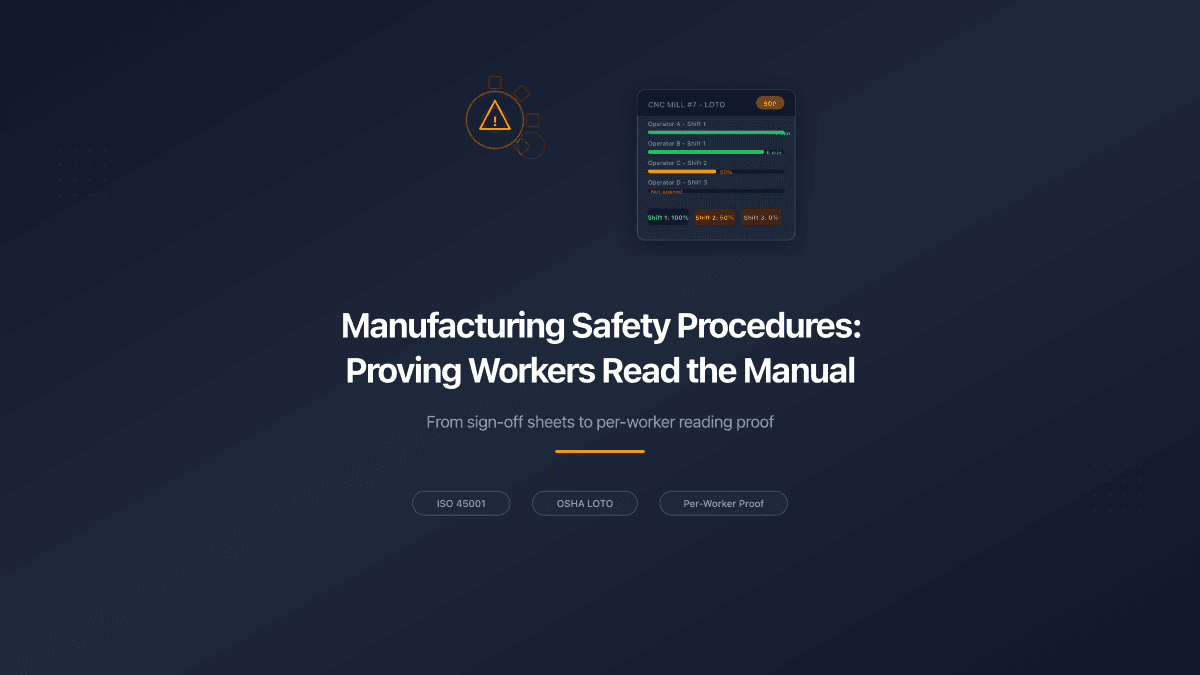
Page-level reading data per procedure. When a machine operator is assigned the lockout/tagout procedure for their specific equipment, page-level analytics show whether they viewed every step. A 12-page procedure "completed" in 8 seconds is not reading. Consistent time across pages over several minutes is.
Procedure-specific completion tracking. Not "LOTO training completed" but "Worker A read CNC Mill #7 LOTO procedure (all 12 pages, 7 minutes) on March 15." This is the granularity OSHA investigators want.
Version-controlled distribution. When an SOP is updated, the system tracks who read the new version versus the old one. The EHS manager sees exactly which workers need to review the updated chemical handling procedure after a formulation change.
Tab visibility detection. If a worker opens the procedure on a shop floor tablet and walks away to handle a task, the reading timer pauses. Time is counted only when the document is actively on screen. This prevents inflated completion records.
Shift-level compliance dashboards. The EHS manager sees completion rates per shift, per department, per procedure. "First shift: 95% completed fall protection SOP. Second shift: 72%. Third shift: 41%." That targeting replaces the plant-wide email that nobody reads.
| Documentation Type | Sign-Off Sheet | Reading Analytics |
|---|---|---|
| Machine-specific LOTO | "LOTO training attended" | "Read CNC Mill #7 procedure, all 12 pages, 7 min" |
| Chemical handling SOP | "HazCom training signed" | "Viewed acetone SDS pages 1-4, safety procedures page 5-8, 11 min" |
| Quality procedure update | "ISO procedure acknowledged" | "Read updated QC inspection v3.2, all pages, returned to Section 4 twice" |
| New equipment manual | "Orientation completed" | "Viewed operating manual for Press Line C, completion 85%, 22 min" |
Incident Investigation: Where Documentation Matters Most
When OSHA investigates a workplace injury, training documentation becomes evidence. The quality of that evidence shapes the outcome.
Scenario: a worker suffers a laceration from an unguarded point of operation on a press brake. The investigation examines whether the worker received training on machine guarding and safe operating procedures.
With sign-off documentation: The plant produces a sign-off sheet from six months ago. The worker's name appears on the list for "Press Safety Training." The sheet does not indicate which specific procedures were covered or whether the worker engaged with the material.
With reading analytics: The plant produces a record showing the worker viewed the Press Brake Operating Procedure on a specific date, spent 9 minutes reading all 10 pages, and returned to review the guard adjustment section twice. A separate record shows the worker did not complete the updated procedure distributed two weeks before the incident.
The second scenario gives the investigation actionable information. It shows the plant trained the worker. It identifies the specific gap (the recent update) that may have contributed to the incident. It demonstrates a systematic approach to training verification.
Reading analytics do not replace hands-on training, practical demonstrations, or supervisor verification. They document the reference material component - the written procedures that workers must understand to operate safely. The best training programs combine classroom instruction, practical exercises, and documented reading of written procedures.
How This Works on the Plant Floor
The workflow fits into existing EHS processes:
- Upload the procedure document - LOTO instructions, SOP, chemical SDS, quality manual section - to a document sharing platform with built-in analytics
- Generate tracked links per worker, per shift, or per department
- Distribute through the channel workers already use - email, QR code posted at the workstation, link in the safety management system, or direct message
- Workers open the link on a shop floor tablet, phone, or kiosk. No app download, no account creation needed
- The analytics engine records every viewing session: pages viewed, time per page, completion, return visits
- The EHS manager reviews a compliance dashboard showing who completed which procedures and follows up with targeted reminders
The worker's experience does not change: read the procedure. The documentation changes from a checkbox to a detailed engagement record.
The Evidence Standard Is Rising
OSHA citations, ISO certification audits, and incident investigations are all moving toward the same expectation: prove your workers understood the procedure, not that they attended a session.
ISO 45001 requires verification that training was effective. ISO 9001 requires evidence of competence, not attendance records. OSHA investigators look for documentation that connects specific workers to specific procedures with evidence of engagement.
Sign-off sheets met the minimum standard for decades. Page-level reading analytics meet the standard the industry is moving toward. The plants that adopt this evidence standard now will face auditors with data. The ones that rely on sign-off sheets will discover the gap when an inspector or an attorney asks the question that matters: "Can you prove they read it?"
PaperLink tracks page-by-page viewing analytics for shared documents - including time per page, completion percentage, and tab visibility detection. Manufacturing plants use it to distribute SOPs, LOTO procedures, and safety manuals with a complete reading audit trail per worker. Try it free.