A counterparty signs the NDA. Six months later, they disclose confidential information. In the dispute that follows, their defense is predictable: "I didn't understand the scope of the restrictions." Your evidence that they read the agreement? An email with a PDF attachment.
This is the gap most law firms live with. NDAs, engagement letters, settlement agreements, and due diligence packages are sent as email attachments or download links. The firm knows the document was delivered. It has no idea whether the recipient opened it, read it, or skipped to the signature page.
In contract law, delivery and awareness are not the same thing. Courts care about whether a party had reasonable notice and manifested unambiguous assent. An email sent is not notice received. A signature proves intent to be bound, but it does not prove the signer read what they agreed to.
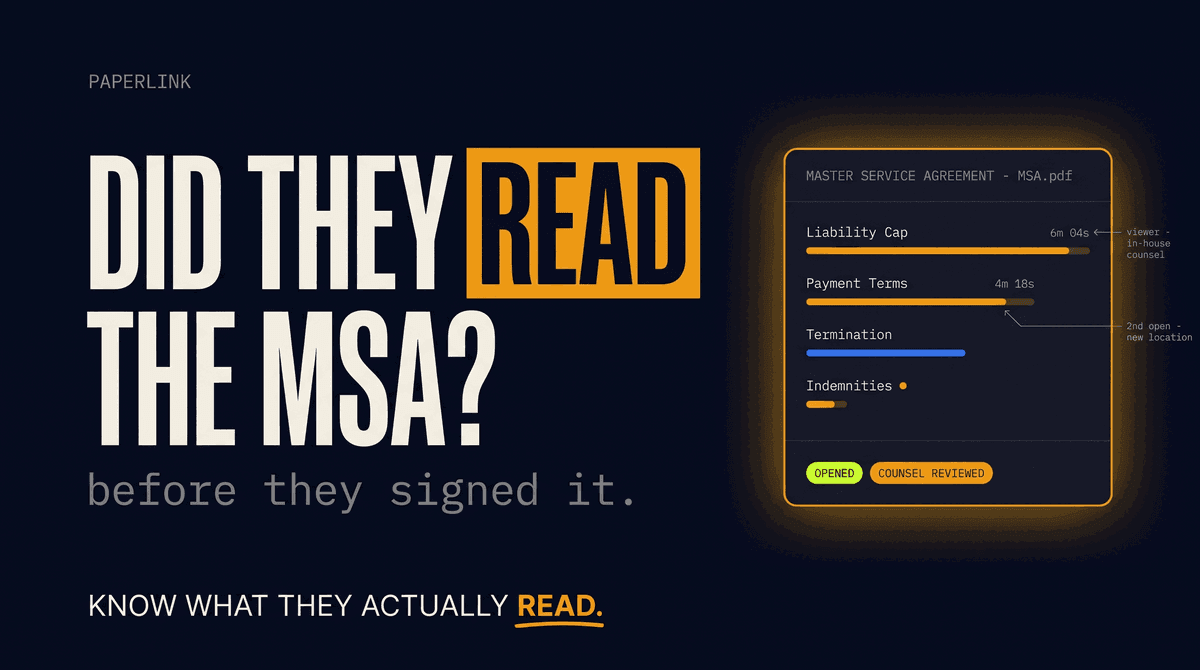
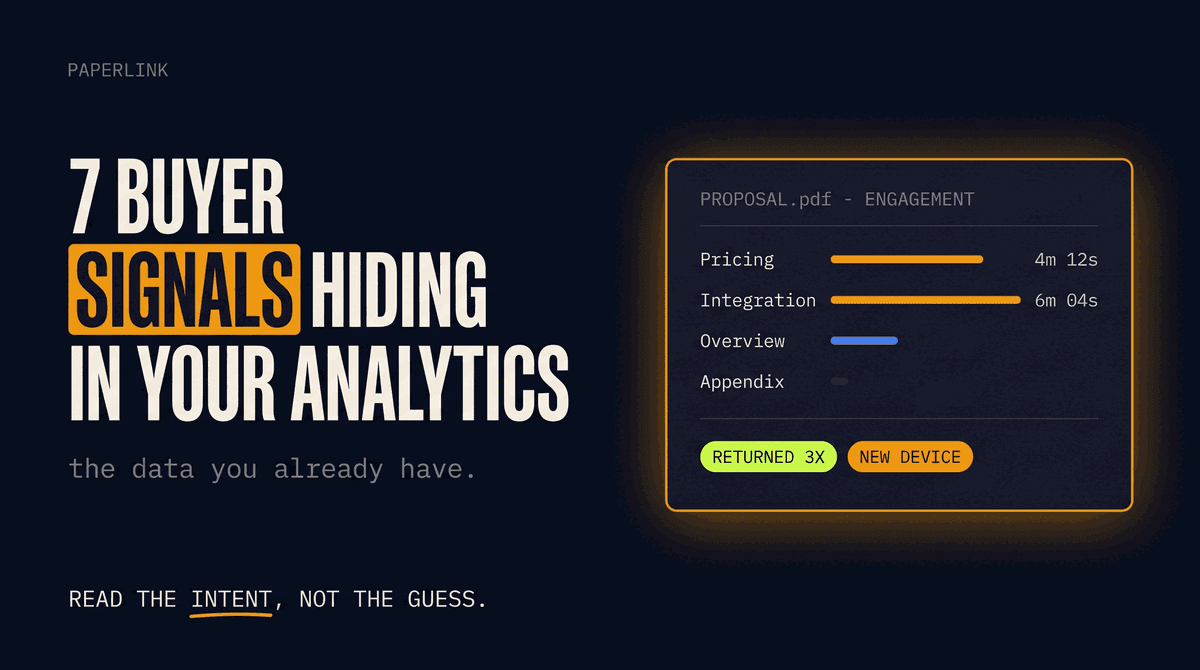
Document reading analytics close this gap. They create a timestamped record of exactly when the recipient opened the document, which pages they viewed, how long they spent, and whether they reached the end.
Why "Sent" Is Not Enough
Email delivery is unreliable evidence. Emails land in spam folders. Attachments fail to download. Links expire. Even when the email arrives, there is no guarantee the recipient opened the attachment.
For routine correspondence, this ambiguity is tolerable. For documents that create legal obligations - NDAs, waivers, settlement terms, regulatory filings - it is a liability.
Consider three scenarios law firms encounter regularly:
NDA disputes. The disclosing party claims the NDA's non-solicitation clause was buried on page 12 of a 15-page agreement and they were not aware of it. If you have page-level reading data showing they spent 45 seconds on page 12 three days before signing, that claim fails.
Engagement letter disputes. A client challenges their fee arrangement, claiming they were not informed of the hourly rate structure. The engagement letter was emailed. Reading analytics show the client opened the letter, viewed all four pages, and returned to page 2 (where the fee schedule appears) twice.
Settlement agreement walk-backs. A party signs a settlement, then seeks to rescind, arguing they did not understand the release of claims. Viewing analytics establish that they spent 18 minutes reading the 8-page agreement across two sessions before executing it.
In each case, the reading data transforms a he-said-she-said argument into documented evidence.
The Clickwrap Lesson for Legal Documents
Courts have spent the last decade establishing a clear standard for electronic agreements. The distinction between clickwrap and browsewrap contracts illustrates what evidence of awareness looks like.
Clickwrap agreements are routinely enforced because users take affirmative action - clicking a checkbox or button - that demonstrates they were presented with the terms. Browsewrap agreements, where terms exist on the website but the user is not required to interact with them, are frequently struck down because users lack constructive notice.
The principle courts apply is consistent: enforceability depends on whether the party had reasonable opportunity to review the terms and took some action demonstrating awareness. In Berman v. Freedom Financial Network LLC, the court held that terms are void unless "reasonably conspicuous" and the user demonstrates "manifest unambiguous assent."
Page-level reading analytics for legal documents apply the same logic. A timestamped record showing the counterparty viewed each page of the NDA for a reasonable duration is evidence of conspicuous notice. It is stronger than an email receipt and stronger than a signature alone.
Reading analytics do not replace signatures or formal execution. They supplement them. The signature proves intent to be bound. The reading data proves awareness of what was agreed to. Together, they create a stronger enforceability record than either provides alone.
What Law Firms Should Track
Not all document analytics are relevant for legal purposes. The metrics that matter in a dispute are the ones that establish awareness and engagement:
Page-level viewing time. Which pages did the recipient view, and for how long? This is the core evidence. A party who spent 90 seconds on the non-compete clause cannot credibly claim they were unaware of it.
Completion percentage. Did the recipient view every page of the agreement? A 15-page NDA where the recipient viewed only pages 1, 2, and 15 (the signature page) tells a different story than one where all 15 pages were viewed sequentially.
Session timestamps. When did the viewing occur relative to execution? A recipient who opened the agreement 48 hours before signing had time to review and seek counsel. One who opened it for 20 seconds before signing raises questions about informed consent.
Return visits. Did the recipient come back to review specific sections? Multiple sessions suggest careful consideration. A single brief session followed by immediate signature may not.
Tab visibility. Was the document actively on screen, or was it open in a background tab while the recipient worked on something else? Analytics that pause when the document is not visible provide a more accurate engagement metric.
| Metric | What It Proves | Relevance in Disputes |
|---|---|---|
| Page-level time | Which provisions the party reviewed | Defeats "I didn't see that clause" defenses |
| Completion % | Whether they read the full document | Establishes comprehensive notice |
| Session timestamps | When they reviewed relative to signing | Shows opportunity to seek counsel |
| Return visits | Deliberate re-review of sections | Demonstrates careful consideration |
| Total reading time | Overall engagement depth | Distinguishes reading from skimming |
Due Diligence and Data Rooms
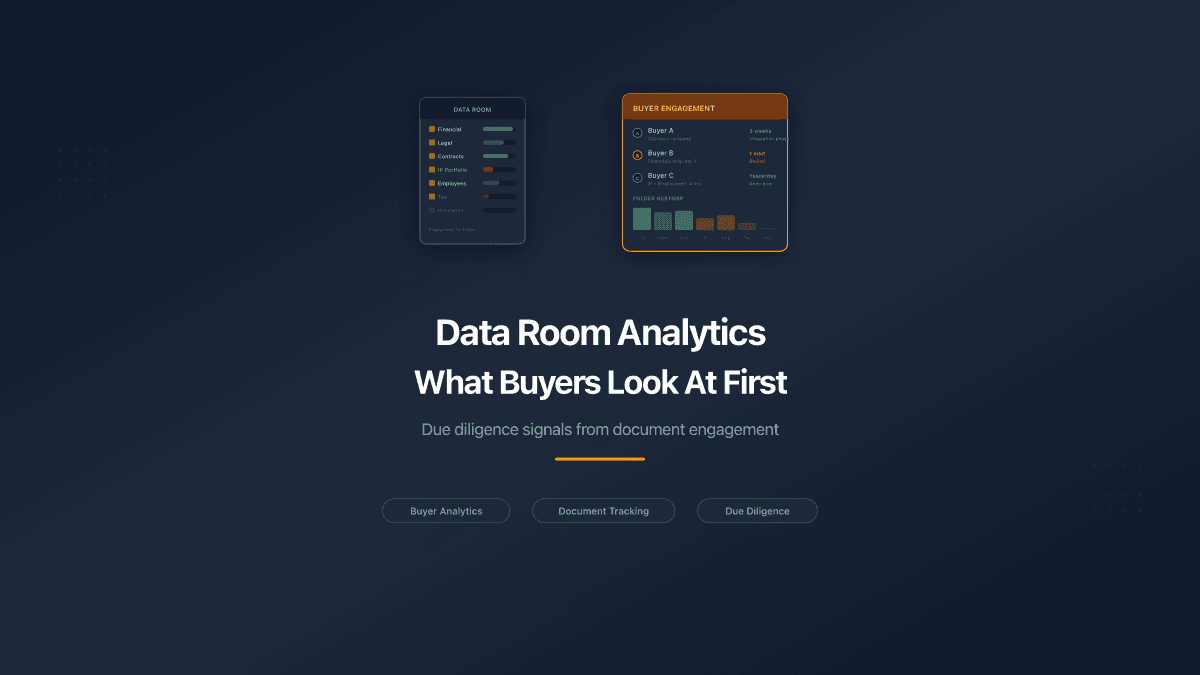
M&A transactions generate thousands of documents shared through virtual data rooms. Buyer's counsel, seller's counsel, and multiple advisory teams access the same repository. Knowing who reviewed which documents - and how thoroughly - is relevant at several stages.
Pre-closing diligence. If a post-closing dispute hinges on whether the buyer was aware of a particular liability disclosed in the data room, the seller's defense is stronger with evidence that buyer's counsel spent 22 minutes reviewing the relevant disclosure schedule.
Representation and warranty claims. A buyer claiming a warranty breach related to a matter disclosed in the data room faces a tougher argument if analytics show their team accessed and reviewed the disclosure document before closing.
Professional liability. If counsel fails to identify a material issue buried in a data room, per-document viewing analytics can establish whether the document was accessed at all - relevant to malpractice claims.
Virtual data rooms from providers like Datasite, Firmex, and DealRoom include document-level access logs. These platforms show which buyers, advisors, and legal teams reviewed materials, how long they spent, and what they revisited. The more granular the tracking, the more useful the evidence.
Beyond NDAs: Documents That Need Reading Proof
Law firms handle a range of documents where reading verification strengthens the legal position:
Engagement letters and retainer agreements. Client disputes about scope, fees, or conflicts are easier to resolve when the firm can demonstrate the client reviewed the engagement terms.
Waivers and releases. A waiver signed without reading is more vulnerable to challenge than one where reading analytics show the signer spent meaningful time with the document.
Regulatory submissions. When a filing is shared with a client for review before submission, reading analytics confirm the client had the opportunity to flag errors or omissions.
Board materials. Directors who claim they were not informed about a matter discussed in board materials face a different evidentiary landscape when document analytics show they accessed and reviewed those materials.
Disclosure schedules. In any transaction, the schedules attached to the agreement contain the specific facts. Analytics that show which schedules each party reviewed - and which they did not - create a factual record for post-closing disputes.
Document analytics are evidence, not legal advice. The admissibility and weight of reading analytics in a specific jurisdiction depends on applicable rules of evidence and the court's discretion. Firms should consult their own litigation teams about how to preserve and present this data.
How This Works for Law Firms
The practical workflow does not require firms to change how they draft or execute documents. It adds a tracking layer to the distribution step:
- Upload the document - NDA, engagement letter, settlement agreement, or data room package - to a document sharing platform with built-in analytics
- Generate a tracked sharing link with appropriate access controls (password protection, email verification, or NDA requirement before viewing)
- Send the link to the counterparty, client, or advisory team through normal channels
- The recipient clicks the link and reads in a secure browser-based viewer - no download required, no separate account needed
- The analytics engine records the viewing session: pages viewed, time per page, completion, timestamps, device
- The firm retains the analytics record alongside the executed agreement in the matter file
The counterparty's experience is simple: they receive a link, open it, and read. The firm gets a timestamped record of engagement that persists as long as the matter file.
For data rooms, the same principle applies at scale. Each document in the repository is tracked individually. The firm can generate a report showing which counsel accessed which documents, when, and for how long - useful for both diligence management and post-closing evidence.
Evidence That Stands Up
Law firms build cases on evidence. When the question is "did they read it?" - and that question arises in NDA disputes, fee challenges, settlement rescissions, and post-closing warranty claims - the answer should be data, not assumption.
A sent email proves you tried. A signature proves they agreed. Page-level reading analytics prove they knew what they were agreeing to.
For tracking a specific high-stakes contract, see How to Know If Your MSA Was Read Before It Was Signed.
PaperLink tracks page-by-page viewing analytics for shared documents - including time per page, completion percentage, and session timestamps. Law firms use it to share NDAs, engagement letters, and due diligence packages with a complete reading audit trail. Access controls include password protection, email verification, NDA requirement, and link expiration. Try it free.