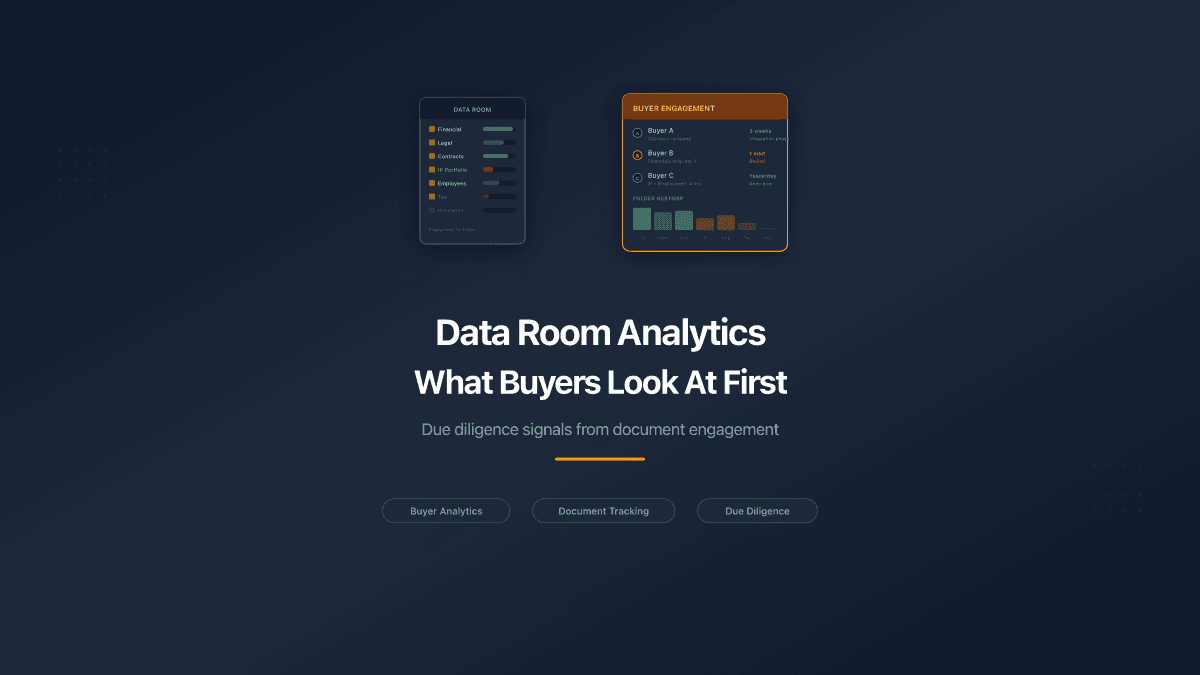
Three buyers have access to your data room. One has reviewed 200 documents across every folder over three weeks. Another opened the financial statements on day one and has not returned. The third logged in yesterday and spent four hours on the IP portfolio and employment agreements.
Without analytics, all three look the same: they have access. With analytics, each tells a different story - and the story shapes how you manage the deal.
Analytics in a virtual data room track which users access which documents and for how long, providing the deal team with real-time intelligence on buyer engagement throughout the due diligence process. This data is not a bonus feature. In competitive processes, it determines which buyers receive additional information, how negotiations are sequenced, and whether the deal timeline needs to accelerate or extend.
What Buyers Review First
Due diligence follows a predictable pattern. Buyers do not open the data room and read alphabetically. They follow a hierarchy of concern - starting with the documents that determine whether the deal is worth pursuing and progressing to the details that shape terms.
Phase 1: Financial validation. The first documents reviewed are almost always financial statements, revenue breakdowns, and P&L summaries. The buyer is answering one question: "Does this business perform the way the teaser suggested?" Time spent on financial documents in the first 48 hours is a strong signal of initial interest level.
Phase 2: Legal and contractual risk. After the financials pass initial review, buyers move to contracts, compliance documents, and litigation history. They are looking for deal-breakers: pending lawsuits, onerous contract terms, regulatory exposure, or customer concentration risk. Extended time in the legal folder early in the process often indicates a cautious buyer with active legal counsel.
Phase 3: Operational depth. Buyers who move past financials and legal into customer data, employee records, technology architecture, and IP documentation are conducting serious evaluation. This phase typically begins in the second week and involves multiple team members - financial analysts, technical evaluators, and operations specialists.
Phase 4: Integration planning. The deepest level of engagement: organizational charts, employment agreements, real estate leases, vendor contracts. Buyers reviewing these documents are planning how to operate the business post-acquisition. If your analytics show a buyer spending time here, they are likely preparing an offer.
The progression from financials to operational documents is not linear. Serious buyers frequently return to financial documents after reviewing operational data - revising their models with new information. Return visits to the financial folder after an operational deep-dive are a strong buying signal.
Reading the Engagement Signals
Data room analytics turn passive document access into active deal intelligence. Sellers can obtain deal intelligence from auditing and reporting tools, which help ascertain who is looking at what documents to gauge their levels of interest. Here is what the patterns mean:
High-Interest Signals
| Pattern | What It Means | Deal Implication |
|---|---|---|
| Multiple team members accessing simultaneously | Diligence team is active and coordinated | Buyer is investing resources - likely preparing an offer |
| Return visits to financial models | Revising their valuation | Interest is real - they are modeling scenarios |
| Deep review of employment agreements | Planning post-close workforce | Integration planning has started |
| Q&A questions about specific contracts | Legal team is identifying risk | Buyer is serious enough to involve counsel |
| Daily access over consecutive weeks | Systematic, thorough review | This is a committed buyer |
Low-Interest or Risk Signals
| Pattern | What It Means | Deal Implication |
|---|---|---|
| Single login, no return | Checked the box, not interested | Deprioritize this buyer |
| Only financial summary viewed | Evaluating at surface level | May need more engagement or a management presentation |
| Access stopped after legal review | Found something concerning | Address the concern proactively or accept likely withdrawal |
| No access for 7+ days | Lost momentum or interest | Check in with the buyer's advisor |
| Download of all documents at once | Preparing to share externally or analyze offline | Verify NDA compliance and access controls |
Competitive Intelligence
In a multi-buyer process, analytics provide comparative intelligence. Data room analytics surface behavioral patterns - specifically highlighting comparative interest across bidders. If Buyer A has reviewed 80% of the data room while Buyer B has reviewed 30%, the deal team knows which conversations to prioritize.
This intelligence also informs information staging. Based on progress achieved during due diligence, the deal manager releases additional levels of documentation to those bidders who indicate appropriate levels of interest. Analytics determine who earns access to the next tier of sensitive information.
Organizing the Data Room for Maximum Engagement
Data room structure affects how buyers navigate - and therefore what the analytics capture. A well-organized room produces cleaner engagement signals than a disorganized one.
The Standard M&A Data Room Structure
| Folder | Contents | Why It Matters |
|---|---|---|
| 1. Corporate | Articles of incorporation, board minutes, organizational chart | Establishes the legal entity and governance |
| 2. Financial | Audited financials, management accounts, revenue breakdown, projections | First stop for every buyer - must be complete and current |
| 3. Tax | Tax returns, assessments, correspondence with authorities | Tax exposure can reshape deal economics |
| 4. Contracts | Customer contracts, supplier agreements, partnership deals | Revenue quality and contractual obligations |
| 5. Employees | Employment agreements, benefit plans, organizational chart, key person terms | Workforce cost structure and retention risk |
| 6. IP | Patents, trademarks, trade secrets, license agreements | Value driver for technology and pharma deals |
| 7. Litigation | Pending cases, settlement history, regulatory inquiries | Deal-breaker category - buyers examine carefully |
| 8. Real Estate | Leases, property ownership, environmental assessments | Operational cost base and liabilities |
| 9. Insurance | Policies, claims history, coverage gaps | Risk transfer assessment |
| 10. Regulatory | Licenses, permits, compliance certifications | Operational continuity post-close |
Number your top-level folders. Buyers navigate by folder order, and analytics tied to numbered folders produce cleaner engagement reports. "Folder 2: Financial" is easier to reference in deal team meetings than "the folder labeled Financial Statements and Related Documents."
What Good Organization Reveals
When folders are structured logically, the analytics tell a story. A buyer who spends two hours in Folder 2 (Financial), 45 minutes in Folder 4 (Contracts), and 30 minutes in Folder 6 (IP) has a clear due diligence focus: they are evaluating the business's commercial fundamentals.
A buyer who starts with Folder 7 (Litigation) is risk-focused - possibly because their own legal team flagged a concern from public records. Knowing this lets the seller prepare a response before the buyer raises the issue formally.
A poorly organized room - where financial documents, contracts, and employee records are scattered across ambiguously named folders - produces ambiguous analytics. The deal team cannot tell whether a buyer is studying financials or accidentally browsing the wrong folder.
Per-Document Analytics That Matter
Beyond folder-level access, per-document analytics provide granular intelligence:
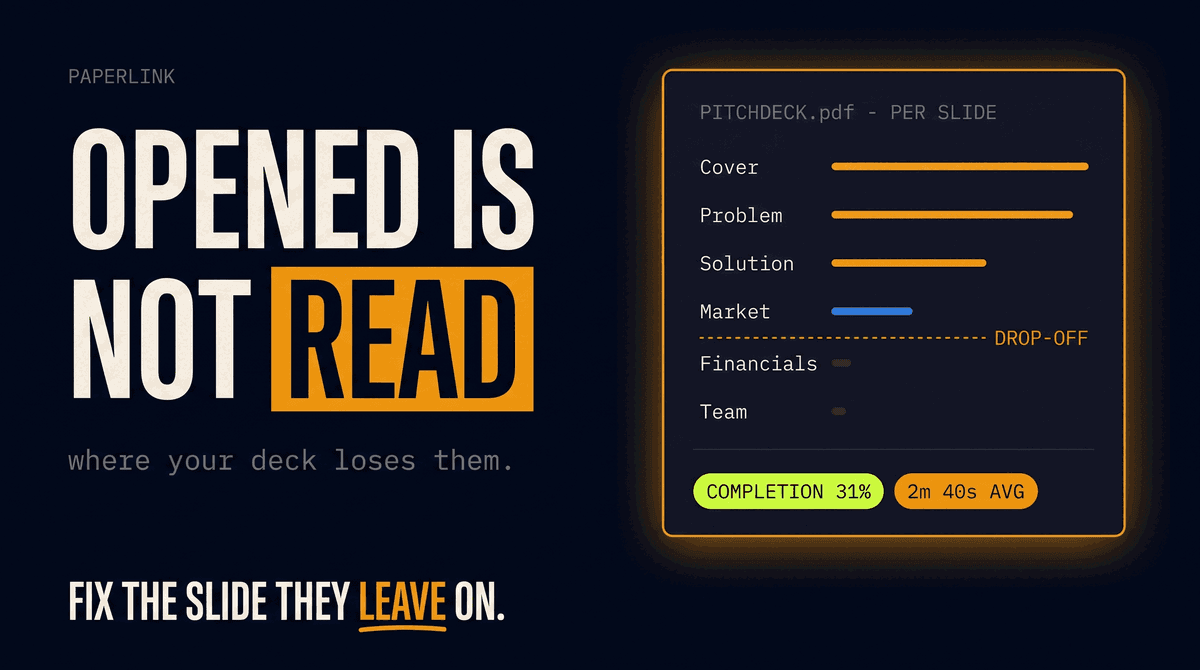
Time per page. A buyer who spends 20 minutes on a 40-page customer contract is reading it closely. One who spends 30 seconds opened and scanned for a specific clause. Both are useful signals, but they indicate different levels of diligence depth.
Completion rate. Did the buyer view every page of the disclosure schedule? Partial viewing of a critical document suggests either limited interest or time pressure. In a competitive process, a buyer who has not completed reviewing key documents may need a deadline extension - or may be deprioritized.
Viewer identification. Analytics that identify individual viewers reveal team composition. When a buyer's CFO appears in the financial folder alongside their external legal counsel in the contracts folder, the deal team knows multiple workstreams are active. If only a junior analyst is accessing the room, the deal may not have reached the decision-maker level yet.
Session patterns. A buyer who accesses the room during business hours on weekdays is working through a standard process. One accessing the room at midnight and on weekends is either under time pressure or deeply motivated. Both are signals worth noting.
What Analytics Cannot Tell You
Data room analytics are powerful but not omniscient. Important limitations to recognize:
Downloading vs. reading. A buyer who downloads a document may read it offline - and the analytics will not capture that reading. Download tracking shows what was taken, not how it was consumed afterward. This is why view-in-browser analytics (where the document is read in the data room viewer without downloading) produce richer engagement data than download-heavy environments.
Team discussions. A buyer's deal team may have one person access the data room and share findings verbally with colleagues. The analytics show one viewer, but four people may be evaluating the information. Low user counts do not always mean low interest.
Intent. A buyer deeply reviewing litigation documents might be planning to negotiate a price reduction - not planning to walk away. Analytics show engagement patterns, not motivations. The deal team must interpret the data in context.
External information. Buyers also conduct diligence outside the data room - public records, customer reference calls, industry research. Data room analytics capture one channel of the buyer's evaluation, not all of it.
Set appropriate access controls before granting data room access. NDA requirements, watermarked downloads, email verification, and link expiration dates protect sensitive deal information. Analytics identify who is looking - but they work best alongside controls that govern who can look and what they can do with what they find.
From Analytics to Action
The value of data room analytics is not the data itself - it is the decisions the data enables:
Prioritize management presentations. When two buyers are at different engagement levels, schedule the management presentation with the more engaged buyer first. Their deeper familiarity with the data room means more productive meetings.
Anticipate questions. A buyer who spent three hours on the employment agreements will ask about key person risk, retention bonuses, and post-close workforce plans. Prepare answers before the meeting, not during it.
Manage the timeline. If the most engaged buyer's access patterns show they are nearing the end of their review (systematic completion across all folders), the deal team can begin preparing for offer submission. If they are still in early-stage review, pushing for a premature deadline risks losing them.
Identify disengaged buyers early. In a competitive process, a buyer with data room access who has not logged in for two weeks is unlikely to submit a competitive offer. The deal team can focus energy on active participants rather than chasing dormant ones.
Protect the process. If analytics show a buyer's access patterns do not match their stated intentions - claiming to be in advanced diligence while only having reviewed summary documents - the seller can adjust expectations and communications accordingly.
The Deal Is in the Data
Every M&A transaction generates uncertainty. Buyers do not announce their intentions through the data room. But their behavior in the data room reveals those intentions more reliably than their words.
A buyer who tells you "we're very interested" but has not logged into the data room in three weeks is telling you two things at once. The analytics separate what buyers say from what they do.
The sellers who read these signals - and act on them - manage deals with information instead of intuition. The data room is not just where documents live during due diligence. It is where buyer intent becomes visible.
PaperLink offers virtual data rooms with page-by-page viewing analytics, per-document time tracking, and viewer identification. Organize documents in nested folders, share via a single secure link with NDA requirements and access controls, and track buyer engagement in real time. Try it free.