A worker signs the toolbox talk sheet, grabs a hard hat, and walks onto the scaffold. Did they read the fall protection procedure? The sign-off sheet says yes. Reality says you have no idea.
Construction safety documentation has operated on the honor system for decades. A clipboard goes around. Workers sign next to their name. The sheet goes into a binder. When an OSHA inspector asks for proof of training, that binder is your defense. But a signature proves one thing: the worker held a pen. It does not prove they read, understood, or even glanced at the safety material.
In an industry where 1,032 workers died on the job in 2024 and fall protection alone generated 5,914 OSHA violations in 2025, the gap between "signed" and "read" is not an administrative inconvenience. It is a safety risk with legal and financial consequences.
What OSHA Actually Requires
OSHA's construction training requirements under 29 CFR 1926.21 are specific: employers must instruct each employee in the recognition and avoidance of unsafe conditions and the regulations applicable to the work environment. Separate standards add training requirements for fall protection (1926.503), scaffolding (1926.454), confined spaces (1926.1204), hazard communication (1910.1200), and dozens of other hazard categories.
Documentation is where contractors stumble. OSHA does not prescribe a specific form or format for training records. But when an inspector arrives - typically after an incident or a complaint - they expect to see evidence that training happened. Missing sign-in sheets or vague topic descriptions equal "no training" in OSHA's view. If your only proof is someone's memory, OSHA treats the training as if it never occurred.
The financial stakes are clear. A serious violation carries a penalty of up to $16,550 per instance. Willful or repeated violations reach $165,514 each. On a site with 40 workers and inadequate fall protection training documentation, the math gets uncomfortable fast.
OSHA requires training records to be retained for at least three years. If an incident occurs and you cannot produce documentation from the relevant period, the training is considered not to have happened - regardless of whether it did.
The EU Raises the Same Bar
The problem is not uniquely American. The EU's Directive 92/57/EEC on temporary and mobile construction sites requires employers to ensure each worker receives adequate safety and health training specific to their workstation or job. Workers from outside undertakings must receive appropriate instructions regarding health and safety risks before they begin work.
Under the EU Framework Directive 89/391/EEC, employers must maintain documentation demonstrating compliance with training requirements. In jurisdictions like the UK (where the Construction (Design and Management) Regulations 2015 apply), Singapore (Workplace Safety and Health Act), and Australia (WHS Regulations), the pattern is the same: regulators expect documented evidence that safety training reached the workers it was meant for.
A paper sign-off sheet satisfies the minimum interpretation of "documentation." But when an incident investigation asks whether a worker understood the confined space entry procedure they signed for three weeks ago, that signature suddenly feels thin.
Why Paper Evidence Fails
Paper-based safety documentation has three structural problems that no amount of organizational discipline can fix.
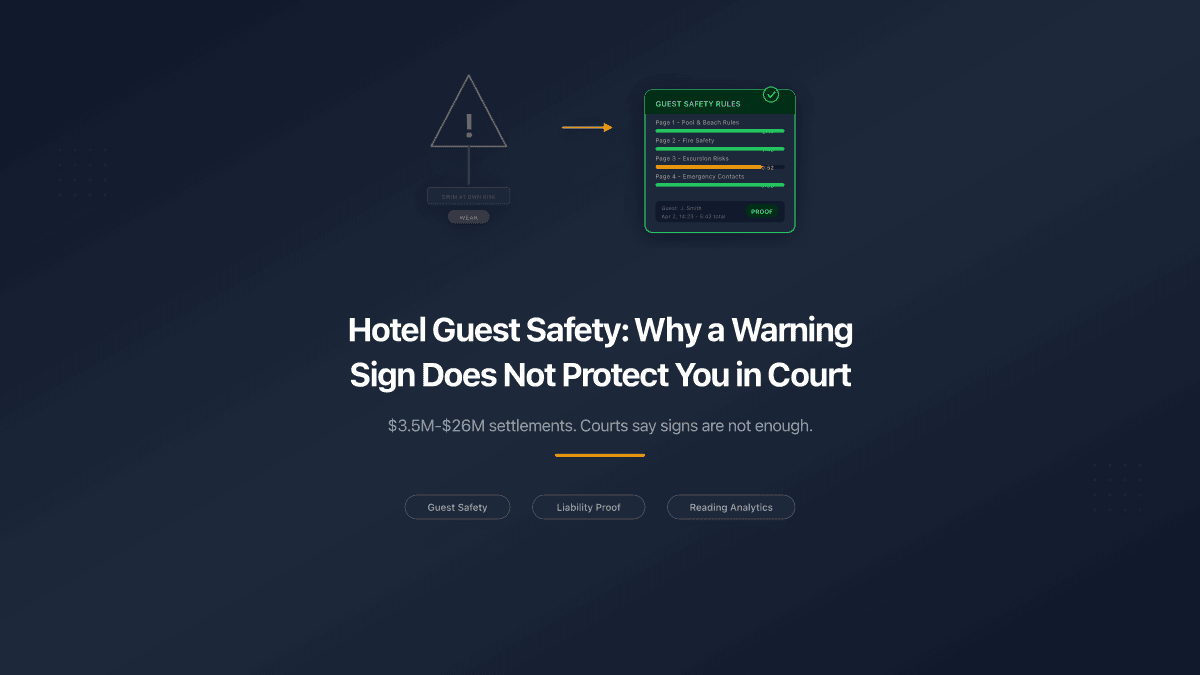
It proves presence, not engagement. A signature on a toolbox talk attendance sheet confirms the worker was physically in the room (or at least near the clipboard). It says nothing about whether they listened, read the handout, or understood the hazard. In a crew of 25, how many are reading while the foreman talks - and how many are checking their phone?
It degrades and disappears. Paper documentation is susceptible to being lost, damaged, or incomplete. Binders get wet. Sheets fall out. Handwriting becomes illegible. Three years later, when OSHA or a plaintiff's attorney asks for the fall protection training record from a specific date, the binder tells a partial story at best.
It cannot scale across sites. A general contractor managing six active sites has six separate binders, six different recording practices, and no centralized view of which workers have completed which training. When a subcontractor's crew moves between sites, their training history does not follow them. The safety manager discovers gaps after the fact - sometimes after an incident.
These are not edge cases. Missing safety training documentation is one of the most common reasons for OSHA citations. The training may have happened. The proof did not survive.
What Real Safety Document Tracking Looks Like
Effective safety document tracking goes beyond digitizing the sign-off sheet. Converting a paper form into a PDF with an e-signature field solves the legibility problem but not the verification problem. The worker still signs without reading.
Genuine reading verification tracks what happens after the worker opens the document:
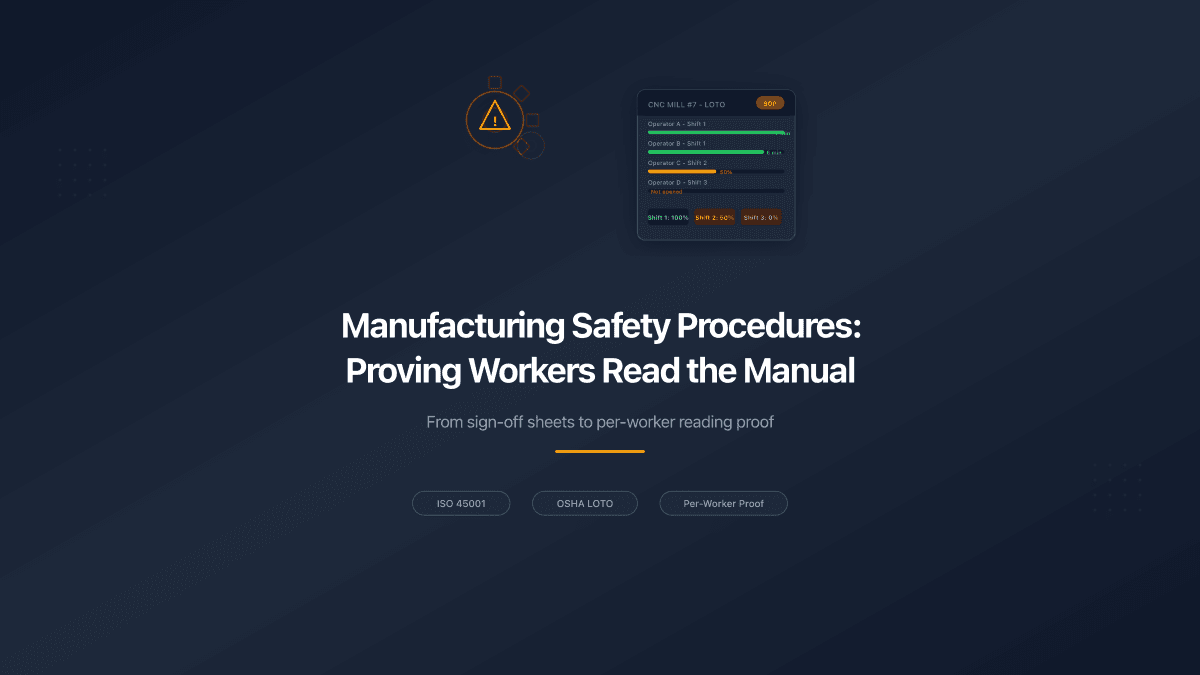
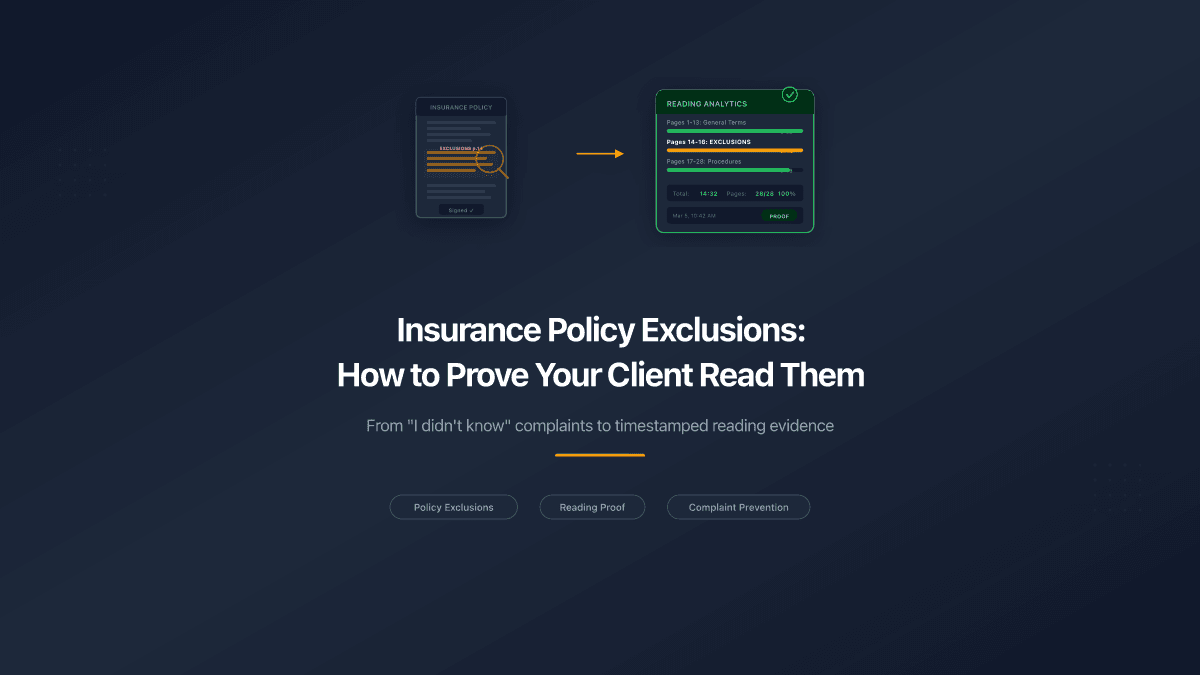
Page-level time tracking. How long did the worker spend on each page of the confined space entry procedure? A 12-page SOP "read" in 15 seconds is not reading. Consistent time across pages - 30 to 60 seconds per page over several minutes - indicates actual engagement.
Completion percentage. Did the worker view every page of the toolbox talk material, or did they scroll to the bottom and close? A safety manager who can see that 8 of 25 crew members only viewed the first two pages of a 10-page fall protection guide has a targeted follow-up list - not a binder full of meaningless signatures.
Tab visibility detection. If the worker opens the safety document on a tablet and switches to another app, the reading timer stops. Time is only counted when the document is actively visible on screen. This prevents the "open it and walk away" pattern that plagues digital sign-off systems as much as paper ones.
Session tracking across multiple visits. A worker opens the hot work permit procedure on Monday morning for two minutes, then returns Tuesday to finish. Both sessions are recorded. The safety manager sees the complete reading history, not just a single timestamp.
Per-worker compliance dashboard. Instead of "all 40 workers signed the toolbox talk sheet," the safety manager sees: "34 workers completed the fall protection procedure with an average reading time of 6 minutes. 4 workers viewed only the first page. 2 workers have not opened the document."
That level of detail changes the conversation with OSHA inspectors, insurance auditors, and - in the worst case - plaintiff's attorneys investigating an incident.
From Sign-Off Sheets to Reading Analytics
The workflow for safety managers does not need to be complicated:
- Upload the safety document - toolbox talk, SOP, permit-to-work procedure, site induction package - to a document sharing platform with built-in analytics
- Generate tracked links for individual workers or for the entire crew (the platform identifies viewers by email or name)
- Distribute the link through the existing channel - WhatsApp group, email, QR code posted in the break room, or the company's safety management system
- Workers open the link on any device - phone, tablet, site kiosk - and read in a secure browser-based viewer. No app download, no account creation
- The analytics engine records every viewing session: pages viewed, time per page, completion, return visits, device type
- The safety manager reviews a dashboard showing crew-level compliance and flags workers who need follow-up
The worker's experience is unchanged: open a link, read the document. The safety manager's evidence goes from "they signed a sheet" to "they spent 7 minutes reading all 10 pages of the fall protection procedure on March 15 at 6:42 AM, from an iPhone on the Riverside project site."
Reading analytics do not replace toolbox talks or in-person safety briefings. They complement them. The foreman still delivers the safety talk. The document provides the reference material. The analytics prove who engaged with it afterward.
Who Needs This
Safety document tracking with reading verification applies across construction roles and project types:
| Role | Use case | What changes |
|---|---|---|
| Safety manager / EHS officer | Toolbox talks, SOPs, site safety plans | Moves from "distribute and hope" to verified completion rates per crew, per site |
| General contractor | Subcontractor training compliance | Centralized view of which sub crews completed which safety materials across all active sites |
| Project manager | Permit-to-work procedures, method statements | Evidence that the crew read the specific procedure before high-risk work begins |
| Site induction coordinator | New worker orientation packages | Proof that each new worker read the site-specific hazards, emergency procedures, and PPE requirements |
| Insurance / risk manager | Pre-incident documentation | Audit-ready evidence of safety training engagement - not just distribution |
The common thread: every role needs to prove that safety information reached the people it was meant for - and that those people engaged with it. A signature cannot do this. Reading analytics can.
Toolbox Talks Deserve Better Evidence
Construction safety has improved dramatically over the past two decades. Fatal falls investigated by federal OSHA dropped from 234 to 189 in 2024, a decrease of almost 20 percent. Digital tools for hazard reporting, site inspections, and incident management are now standard on large projects. But training documentation - the proof that workers know the rules - is still stuck in the clipboard era.
The toolbox talk is the backbone of daily safety communication on construction sites. It deserves documentation that matches its importance. When regulators, insurers, and courts ask "did the worker know the procedure?", the answer should be data - not a signature on a weathered sheet of paper.
Paper sign-off sheets had their era. Page-level reading analytics are what comes next.
PaperLink tracks page-by-page viewing analytics for shared documents - including time per page, completion percentage, and tab visibility detection. Upload your toolbox talks, SOPs, and site induction packages, then share tracked links with your crew. Start tracking for free.