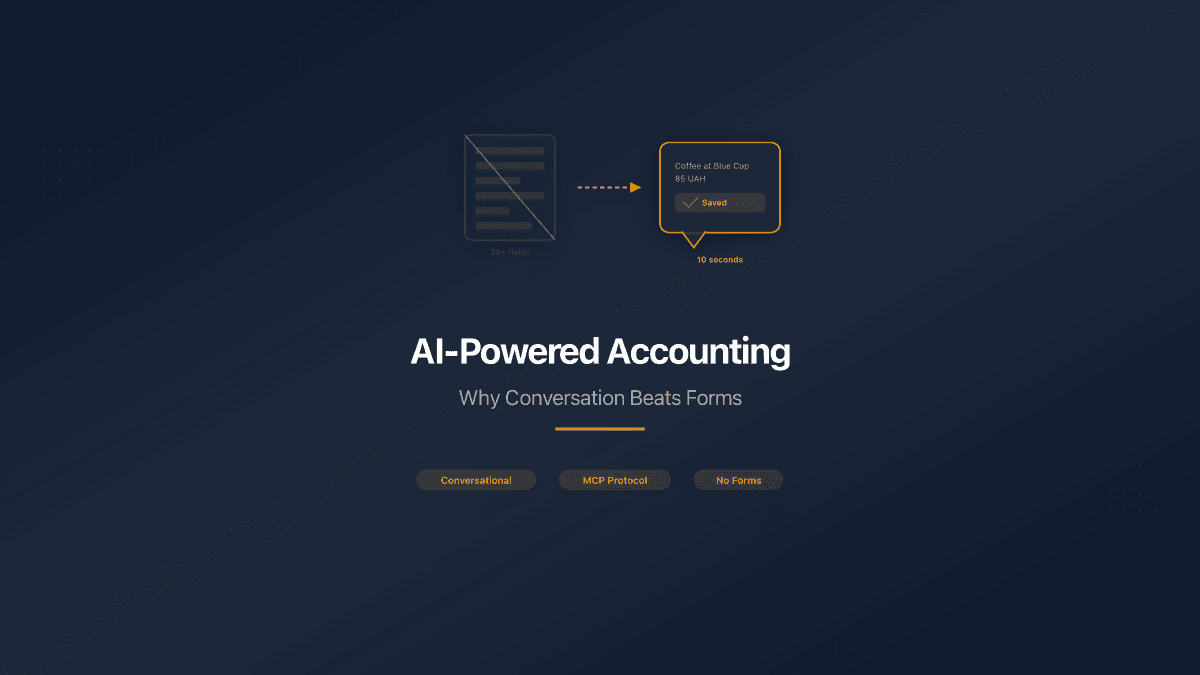
Recording a business expense takes 45 seconds in a form. You open the app, navigate to transactions, pick a type, enter the amount, choose a category from a dropdown, select a bank account, set the date, type a description, and hit save. For a 6-item grocery receipt, multiply that by six.
The same task takes 10 seconds through conversation. "Bought groceries at Silpo, 6 items, total 2165 UAH, Mono Black card." Your AI reads the receipt, categorizes each item, confirms the total, and saves everything in one call.
That speed gap defines the shift happening in accounting software right now. Forms were designed for humans who type. AI speaks. And a new protocol called MCP lets AI speak directly to accounting systems without forms in the middle.
The Problem with Form-Based Accounting
Every accounting tool - QuickBooks, Xero, FreshBooks, Wave - is built around the same interaction model: structured forms with labeled fields. This model works. It is reliable, predictable, and maps cleanly to database schemas. But it has a hard speed ceiling.
Adding a new company with banking details means filling 30+ fields across multiple sections. Updating a client's IBAN means finding the client, opening edit mode, scrolling to banking, changing one field, and saving. Recording transactions from a business trip means creating 15 separate entries, one at a time.
These tasks are not complex. They are tedious. And tedious tasks are where AI creates the most value.
Companies using AI for bookkeeping report up to 80% faster processing and 90% less manual data entry, according to Ramp's 2026 research. Finance teams save 10-15 hours per month on reconciliations alone.
What Conversational Accounting Looks Like
Conversational accounting replaces structured forms with natural language. Instead of navigating to a screen and filling fields, you describe what happened:
- "Coffee at Blue Cup, 85 UAH" - one sentence creates a categorized, timestamped expense
- "Transfer $100 from Wise to Mono Black" - two accounts, currency conversion, exchange rate - handled automatically
- "Add my company ТОВ Прометей, IBAN UA213..., registration 12345678" - 30 form fields reduced to one message
- "Change the hourly rate for Web Development to $175" - partial update without opening any edit screen
The AI handles field mapping, validation, categorization, and storage. If something is ambiguous - "Coffee" matches three categories - the AI asks you to clarify rather than guessing wrong.
This is not autocomplete or smart suggestions bolted onto existing forms. It is a different interaction model where the user describes intent and the system handles execution.
How MCP Makes This Possible
The Model Context Protocol (MCP) is an open standard that connects AI assistants to external tools and data sources. Think of it as a universal adapter between AI and business software.
Before MCP, connecting an AI to accounting software meant building custom integrations for every combination of AI tool and accounting platform. Claude needed a different connector than ChatGPT. QuickBooks needed different code than Xero. Every integration was bespoke.
MCP standardizes this connection. An accounting platform exposes its capabilities as MCP tools - "create transaction," "list clients," "update company." Any MCP-compatible AI assistant can discover and use those tools through the same protocol.
The result: one integration serves every AI client. Claude Code, Cursor, ChatGPT, and future tools all connect through the same endpoint and the same authentication flow.
What the Industry Is Doing
The accounting industry is moving fast on AI integration. Intuit partnered with Anthropic in spring 2026 to bring conversational AI to QuickBooks, TurboTax, and Credit Karma. Xero's built-in AI assistant grew 61% in adoption over the past year.
Both are adding conversational interfaces on top of their existing form-based systems. But they face a structural constraint: their AI is locked inside their own apps. You can talk to QuickBooks through Intuit Assist, but only inside QuickBooks. You can talk to Xero through its AI assistant, but only inside Xero.
MCP removes that constraint. When accounting software supports MCP, your AI assistant of choice connects directly - whatever tool you already use for work. A developer using Claude Code can record expenses without leaving the terminal. A project manager using Cursor can check invoice status without opening a browser tab.
Conversational vs. Form-Based: When Each Wins
Conversational AI does not replace forms everywhere. Each model has strengths:
| Task | Forms | Conversation |
|---|---|---|
| Record a single expense | 45 seconds, 8 fields | 10 seconds, one sentence |
| Batch-enter a receipt (6 items) | 4+ minutes, 48 fields | 15 seconds, one photo |
| Update one field on a client | 30 seconds (navigate + edit + save) | 5 seconds, one sentence |
| Build a complex invoice with line items | Strong - visual layout, drag/drop | Growing - line-by-line via chat |
| Review a financial dashboard | Strong - visual, at-a-glance | Weak - AI summarizes but graphs are better |
| Explore data you have not seen before | Moderate - browse and filter | Strong - ask questions in natural language |
The pattern: conversation wins on data entry and updates (high volume, low complexity). Forms win on visual tasks (dashboards, document layout, chart interpretation). Both have a role.
The fastest workflow combines both. Use conversation for data entry and quick updates. Use the web interface for visual tasks like reviewing dashboards and designing invoice layouts. MCP enables this by keeping the same data accessible through both channels.
What This Means for Small Businesses
For a freelancer or small business owner, the daily accounting burden is real. Receipt entry, expense categorization, client updates, bank reconciliation - these tasks add up to hours per week.
Conversational accounting through MCP cuts that time dramatically. Not because the AI is smarter than the forms, but because natural language is faster than structured input for routine tasks. You already know what happened - "paid Vercel $20 for hosting" - and the overhead of translating that knowledge into form fields is pure friction.
The industry is heading toward what analysts call "ambient AI" - intelligence that operates inside daily workflows rather than in separate tools. MCP is the infrastructure layer that makes ambient accounting possible.
Try Conversational Accounting
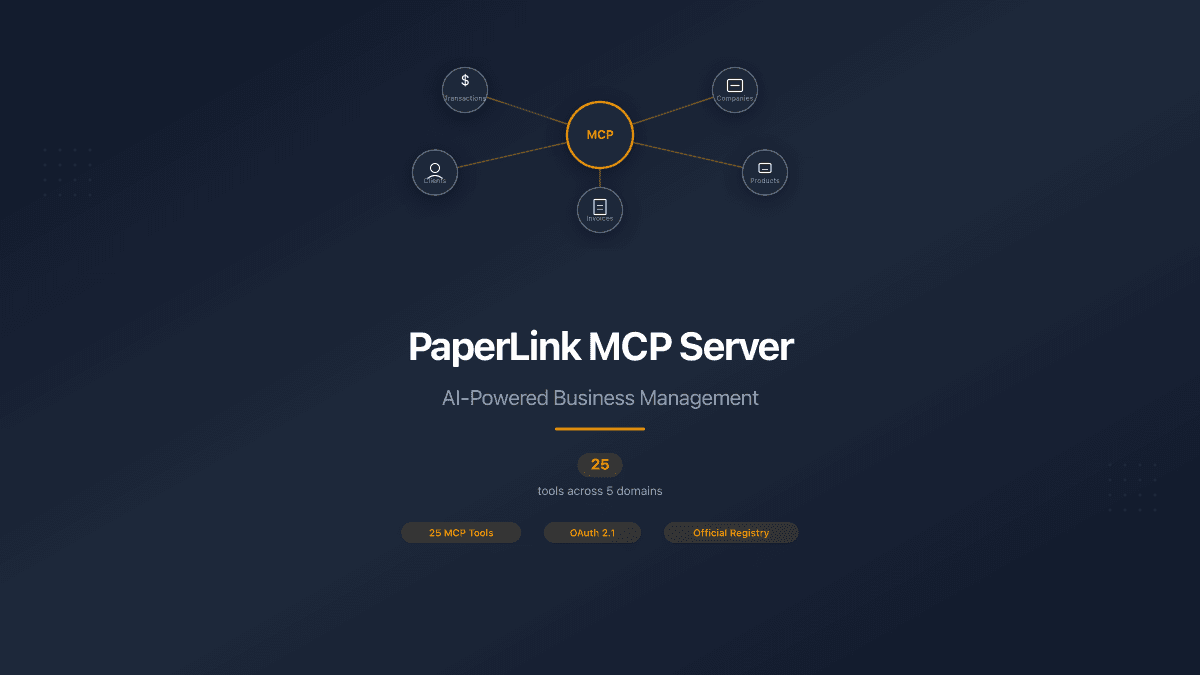
PaperLink's MCP server exposes 25 tools for AI-powered accounting, invoicing, and business management. Create transactions, manage companies and clients, transfer funds between accounts - all through conversation with your AI assistant.
Connect in under 60 seconds and see how much faster accounting gets when you stop filling forms.