The compliance officer's spreadsheet shows 100% policy acknowledgement. Every employee clicked "I acknowledge." Every row is green. The dashboard looks perfect.
Then the auditor arrives. They do not ask whether employees acknowledged the policy. They ask whether employees understood it. They ask for evidence of engagement, not evidence of delivery. And the spreadsheet - every row green, every checkbox ticked - tells them nothing useful.
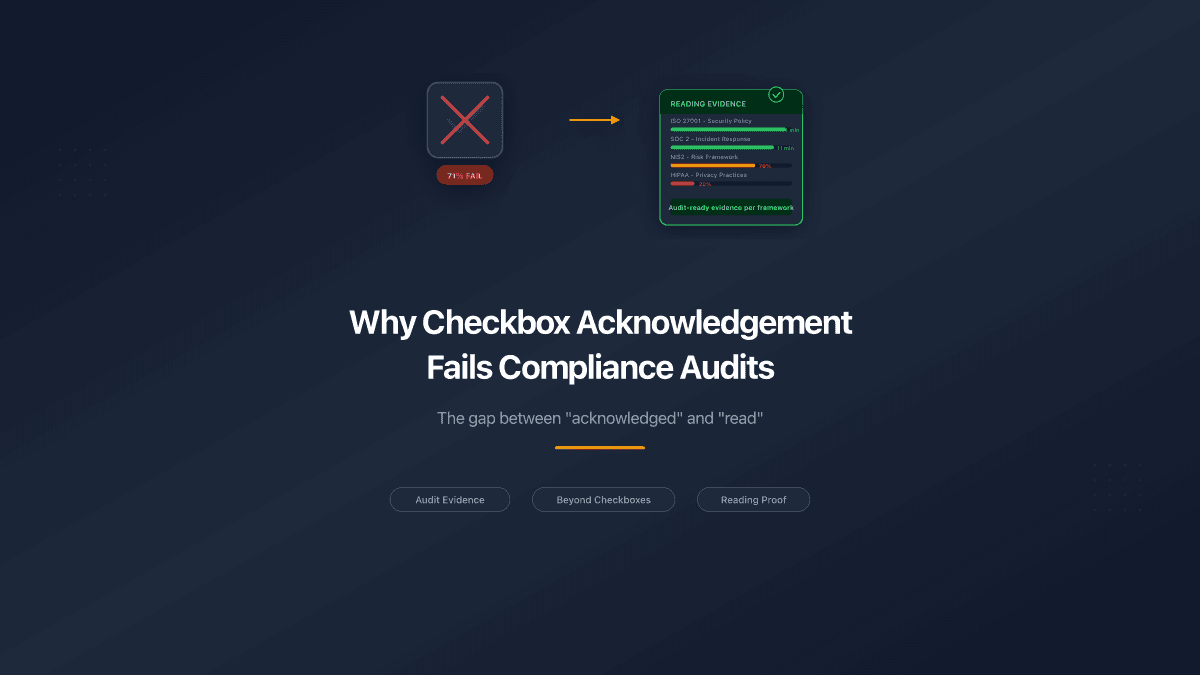
Studies show 71% of organizations are likely to fail their first compliance audit. The reasons vary by framework, but a common thread runs through failed audits across ISO 27001, SOC 2, NIS2, HIPAA, and OSHA: the evidence does not match the requirement. The organization documented that policies were distributed. The auditor wanted evidence that policies were absorbed.
This is the checkbox problem. And it is getting worse as regulatory standards move from "did you distribute it?" to "can you prove they engaged with it?"
What a Checkbox Actually Proves
A policy acknowledgement checkbox - whether on paper, in an LMS, or through an HR system - records one fact: the employee interacted with a prompt. They saw a screen, a form, or an email, and they clicked "Acknowledge," "I agree," or "Completed."
This interaction proves:
- The prompt was presented to the employee
- The employee took an action to dismiss the prompt
- The action was recorded with a timestamp
It does not prove:
- The employee opened the attached policy document
- The employee read any portion of the document
- The employee understood the content
- The employee could apply the policy to their work
- The employee engaged with the specific sections relevant to their role
The gap between what the checkbox records and what the auditor needs is the root cause of documentation failures across compliance frameworks. Compliance reviews are won or lost on evidence, not intent. A checkbox is evidence of intent to comply. It is not evidence of compliance.
How Each Framework Exposes the Gap
The checkbox problem manifests differently depending on which auditor is sitting across the table. But the underlying issue is the same: every major compliance framework now requires evidence that goes beyond distribution confirmation.
ISO 27001 - "Appropriate Awareness"
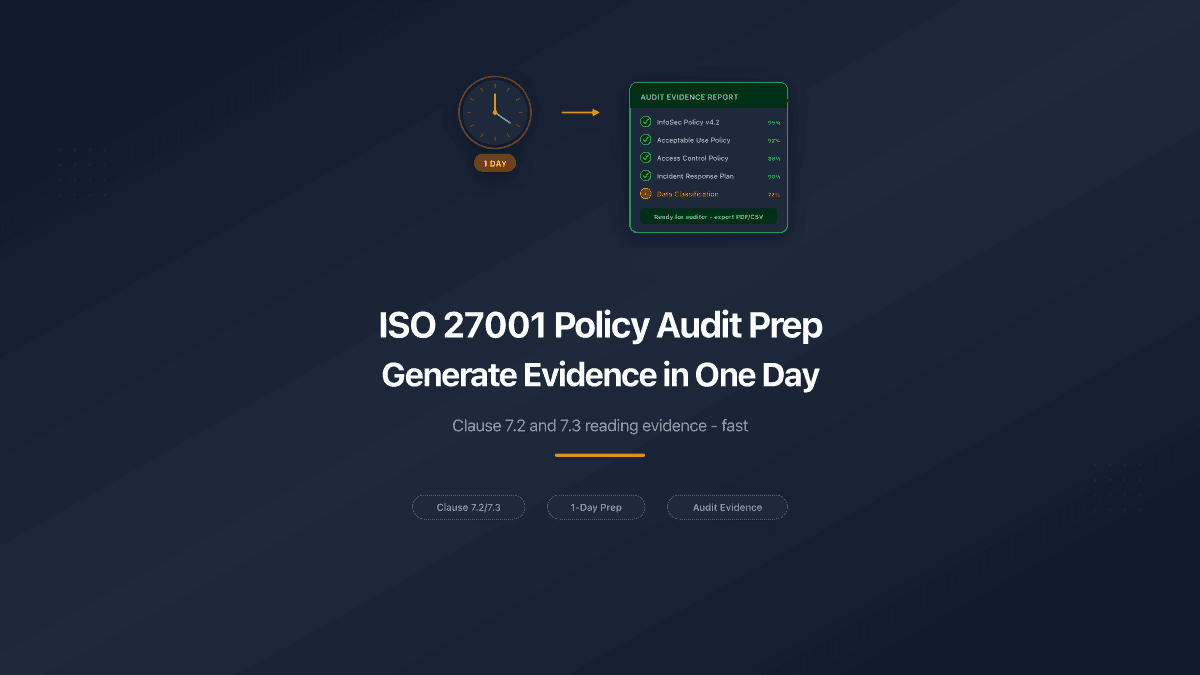
Annex A control A.7.2.2 requires "appropriate awareness education and training and regular updates in organizational policies and procedures." The word "appropriate" is doing heavy lifting. An auditor interpreting this control checks whether the training was relevant to the employee's role and whether the evidence suggests the employee engaged with it.
A checkbox on "Information Security Policy v4.2 - Acknowledged" does not demonstrate appropriateness. It does not show which sections the employee reviewed. It does not distinguish between the CISO who spent 30 minutes reading the incident response plan and the receptionist who clicked through the same document in 4 seconds.
SOC 2 - "Communicated and Acknowledged"
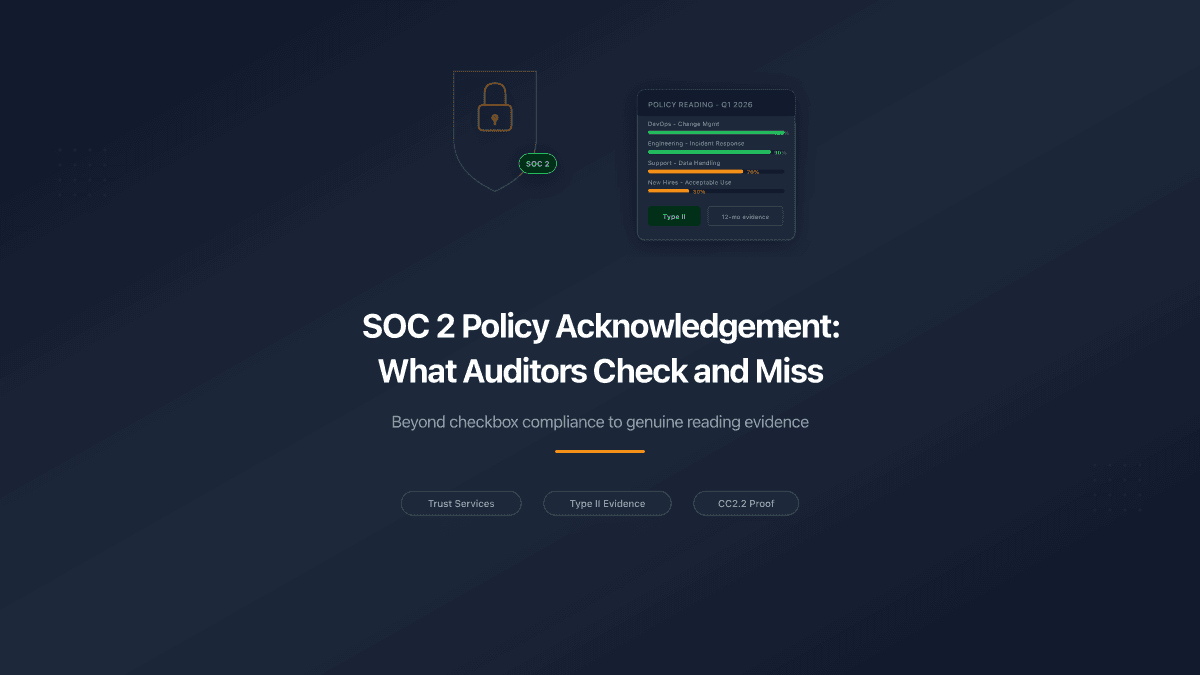
Trust Services Criterion CC2.2 requires internal communication of security policies through multiple channels with evidence of distribution. SOC 2 Type II audits evaluate whether controls operated effectively over a 12-month period. It is not enough to show a policy exists - you must show it is current, assigned, acknowledged, and backed by evidence.
The checkbox satisfies "acknowledged." It does not satisfy "backed by evidence." When the auditor asks "how do you know your engineering team understood the change management procedure?", a completion date is not an answer.
NIS2 - "Demonstrate Through Behavior"
The EU's NIS2 Directive raises the bar higher than any previous framework. Article 20 requires organizations to demonstrate that policies function through people's behavior. Not through their signatures. Not through their checkboxes. Through their behavior.
This language is unprecedented. A checkbox is a record of a click. Behavior implies understanding, retention, and application. Supervisory authorities examining NIS2 compliance will ask for evidence that the workforce knows what the policies require - and a binary completion flag does not satisfy this standard.
HIPAA - "Training That Is Documented"
HIPAA's 45 CFR 164.308(a)(5) requires a security awareness and training programme for all workforce members. The proposed 2026 Security Rule amendments push toward documented competency assessments rather than attendance records.
The shift from "attendance" to "competency" is the clearest signal yet that checkboxes are losing their value as compliance evidence. An LMS completion record proves attendance. It does not prove competency.
OSHA - "Effective Training"
OSHA does not prescribe a training format, but requires that training be effective and documented. When an inspector investigates a workplace incident, they ask whether the worker understood the relevant procedure. A sign-off sheet answers "they were in the room." Reading analytics answer "they spent 7 minutes reviewing the 12-page procedure, viewed every page, and returned to the lockout steps twice."
The regulatory direction is consistent across every framework: the evidence standard is moving from distribution confirmation to engagement verification. Organizations that build engagement evidence now will face audits from a position of strength. Those relying on checkboxes will discover the gap when the auditor asks the question that matters.
The Legal Dimension: Clickwrap and Constructive Notice
Contract law has already solved a version of this problem. Courts distinguish between clickwrap agreements (enforceable - user took affirmative action demonstrating awareness) and browsewrap agreements (frequently unenforceable - user had no constructive notice).
The principle is clear: unless terms are "reasonably conspicuous" and the user demonstrates "manifest unambiguous assent," the agreement is void.
Applied to internal policies: an employee who clicks "acknowledge" without opening the document has not demonstrated manifest assent to the policy's terms. They have demonstrated assent to dismiss the prompt. In an employment dispute or regulatory investigation, the distinction matters.
Courts have consistently found that scrollwrap agreements - where the user must scroll through the terms before clicking accept - are the most enforceable. The parallel for internal policies is reading analytics that prove the employee viewed every page before their acknowledgement was recorded.
What Auditors Actually Look For
Auditors across frameworks share a common evidence hierarchy. Understanding what they value reveals why checkboxes rank near the bottom:
| Evidence Type | What It Proves | Auditor Value |
|---|---|---|
| Policy exists | Organization wrote the policy | Minimum threshold - necessary but insufficient |
| Distribution record | Policy was sent to employees | Shows process exists |
| Checkbox acknowledgement | Employee saw a prompt and clicked | Shows delivery, not reading |
| LMS completion with time | Employee spent X minutes on a module | Better - shows some engagement |
| Page-level reading analytics | Employee viewed specific pages for specific durations | Strongest - shows genuine engagement with specific content |
| Quiz/assessment scores | Employee answered questions correctly | Shows retention at a point in time |
| Behavioral evidence | Employee applied the policy in practice | Ultimate proof - but hardest to document |
Page-level reading analytics sit in the evidence sweet spot: they are stronger than checkboxes, more scalable than quizzes, and more documentable than behavioral observation. They answer the auditor's question - "did they read it?" - with data rather than assumption.
The Five Ways Checkboxes Fail
Beyond the evidence quality issue, checkbox systems have structural weaknesses that create compliance risk:
1. No engagement differentiation. The employee who read the 30-page policy in 25 minutes looks identical to the one who clicked "acknowledge" in 3 seconds. The compliance dashboard shows both as 100% complete. The auditor has no way to distinguish genuine engagement from procedural compliance.
2. No section-level visibility. When an incident occurs related to a specific policy provision, the checkbox cannot answer "did they read the section about data classification?" or "did they review the incident reporting procedure?" It can only answer "did they acknowledge the document?" - which is not the question being asked.
3. No version awareness. When a policy is updated, most systems re-issue the acknowledgement prompt. The employee clicks "acknowledge" again. The record shows they acknowledged version 4.2 on a specific date. It does not show whether they read the changes between version 4.1 and 4.2 - which is what matters after a policy update.
4. No temporal context. A checkbox from January does not prove the employee remembered the policy in July. Reading analytics that show a return visit - the employee came back to review the incident response plan on their own initiative - are stronger evidence of ongoing awareness than a single acknowledgement from months ago.
5. Gameable by design. Employees know checkboxes are compliance theater. The fastest path from "policy distributed" to "policy acknowledged" is a click - no reading required. Most organizations have security policies in place; the problem is getting employees to actually read, understand, and follow them. Checkboxes do not solve this problem. They document it.
The checkbox problem is not limited to employee training. It applies to any scenario where an organization needs to prove a person read a document: client acknowledgement of terms, contractor safety training, board review of governance materials, vendor security agreements. Wherever "acknowledged" is treated as equivalent to "read," the evidence gap exists.
What Replaces the Checkbox
The solution is not eliminating acknowledgement. It is supplementing it with engagement evidence. The checkbox tells the system the employee is done. Reading analytics tell the auditor the employee engaged.
Page-level time tracking records how long the employee spent on each page. This is the single most valuable metric for compliance evidence. An employee who spent 45 seconds on each of 20 pages over 15 minutes engaged with the material. One who "completed" the same document in 8 seconds did not.
Completion percentage shows whether every page was viewed. Opening a document and jumping to the signature page is the digital equivalent of signing the form without reading it. Scroll depth tracking catches this pattern.
Tab visibility detection pauses the reading timer when the employee switches to another application. This prevents the pattern where documents are left open in a background tab while the employee works on something else - creating an inflated time record that does not reflect reading.
Session history captures return visits. An employee who opens the incident response plan on Monday, reads five pages, and returns Thursday to finish demonstrates deliberate engagement. A single brief session followed by a checkbox does not.
Version-specific records tie reading data to a specific document version. When the policy updates, the system tracks who read the new version versus the old one. This is the evidence auditors request after a policy change - and checkboxes cannot provide it.
The Evidence Spectrum by Framework
| Framework | Checkbox Standard (minimum) | Reading Analytics Standard (recommended) |
|---|---|---|
| ISO 27001 | "Policy acknowledged" | "Employee read all sections relevant to their role, avg 14 min, version 4.2" |
| SOC 2 | "Completed within 12 months" | "Engineering team completed incident response plan: 92% completion, avg 11 min" |
| NIS2 | "Training delivered" | "Workforce reading engagement tracked per-policy with anti-gaming protections" |
| HIPAA | "Training completed, cert uploaded" | "Staff read breach notification procedure: per-page data, 6-year retention" |
| OSHA | "Sign-off sheet signed" | "Worker read machine-specific LOTO procedure: all 12 pages, 7 min, per-shift tracking" |
| DORA | "ICT training completed" | "Management body reading evidence per-policy, role-differentiated depth" |
Every framework accepts checkbox acknowledgement as a minimum. None consider it best practice. The organizations that produce reading analytics face audits with confidence. The ones that produce checkboxes face audits with hope.
From Compliance Theater to Compliance Evidence
The term "compliance theater" describes security practices that look correct from the outside but provide no real protection. Checkbox acknowledgement is compliance theater at its most visible: a dashboard full of green indicators backed by zero engagement data.
The shift away from this model is not speculative. It is happening across every major compliance framework:
- NIS2 requires behavioral demonstration
- HIPAA's 2026 amendments push toward competency assessment
- SOC 2 Type II audits examine 12 months of operational evidence
- ISO 27001 auditors verify awareness, not attendance
- OSHA investigators ask whether workers understood procedures, not whether they signed forms
The checkbox had its purpose. It documented distribution at scale when no better technology existed. That technology now exists. Page-level reading analytics turn policy distribution from a checkbox exercise into a documented evidence trail that answers the question every auditor asks: "Did they read it?"
The answer should be data. Not a checkbox.
For a SOC 2-specific walkthrough of turning reading engagement into audit evidence, see How Reading Analytics Strengthen SOC 2 Policy Acknowledgement.
PaperLink tracks page-by-page viewing analytics for shared documents - including time per page, completion percentage, tab visibility detection, and session history. Organizations use it across ISO 27001, SOC 2, NIS2, HIPAA, and OSHA compliance to generate reading evidence that goes beyond checkbox acknowledgement. Try it free.