You submitted everything on time. The permit application, the compliance report, the appeal. Weeks pass. You follow up. The response: "We never received it." Or worse: "We received it but haven't had a chance to review it yet" - six months later.
This is not a niche problem. Anyone who has dealt with government agencies, municipal offices, or regulatory bodies knows the pattern. Documents disappear into inboxes. Officials claim ignorance. And you have no way to prove otherwise - because email delivery confirmation only tells you the message arrived at a server, not that a human being opened the attachment and read it.
There is a better way. Document tracking technology creates a timestamped, verifiable record of exactly who viewed your document, when they opened it, how long they spent reading, and which pages they looked at.
The Gap Between "Delivered" and "Read"
Certified mail proves delivery to a mailbox. Email read receipts prove nothing - recipients can decline them, and most email clients block them by default. Even when a read receipt comes back, it confirms the email was opened - not that the 47-page attachment inside it was reviewed.
The distinction matters. When a zoning board member says "I didn't see the environmental report in the application package," a delivery confirmation is useless. You need proof they opened the report, scrolled through it, and spent twelve minutes on the section about drainage impact.
Traditional proof of delivery answers one question: did the package arrive? Document tracking answers the question that actually matters: did the person engage with the content?
How Document Tracking Works
Instead of emailing a PDF attachment, you share a secure link. When the recipient clicks that link and views the document, the platform records:
- Who opened it - identified by email (if you require email verification before access)
- When they opened it - exact date and time, timestamped
- How long they spent - total viewing duration
- Which pages they read - page-by-page engagement data
- What device they used - desktop, mobile, tablet
- Where they accessed it from - country and general location
This data creates an audit trail that is far more detailed than any certified mail receipt. You know not just that the document was delivered - you know it was consumed.
PaperLink tracks page-by-page viewing analytics for shared documents. When someone opens your link, you see their viewing session in real time - including time spent on each page.
What This Looks Like in Practice
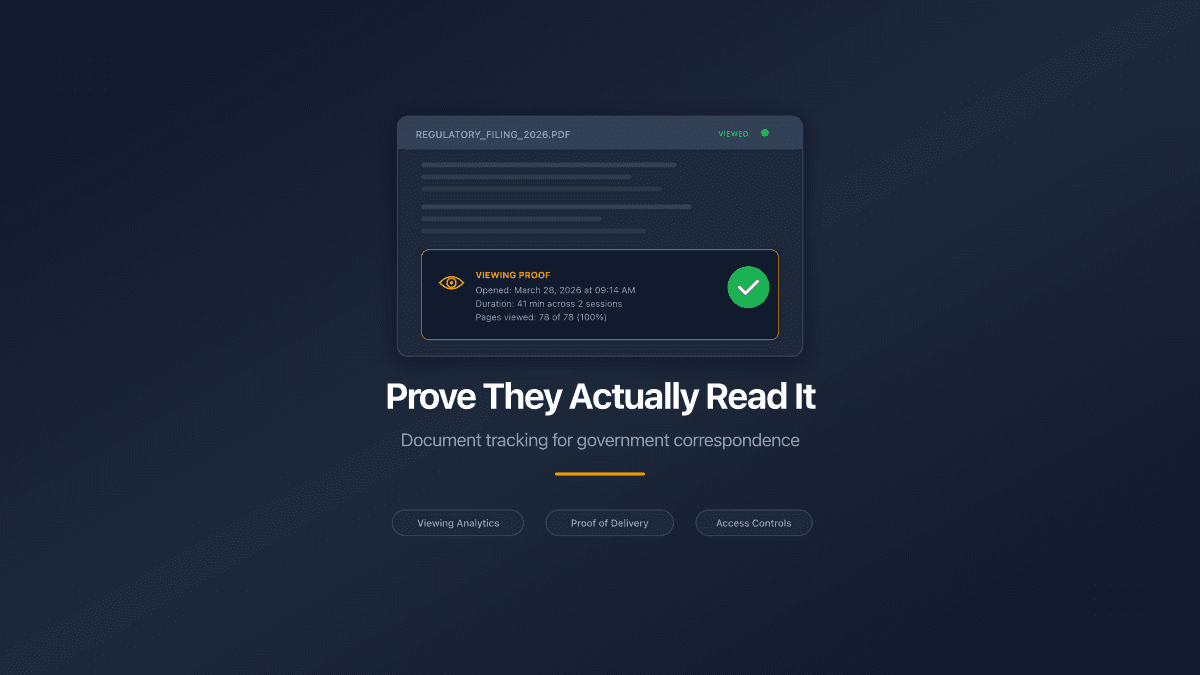
A law firm submits a 78-page regulatory filing to a government agency. The deadline for the agency to respond is 30 business days.
On day 29, the agency claims it needs an extension because it "hasn't had sufficient time to review the materials."
The law firm opens their document analytics dashboard. The data shows:
- The agency contact opened the document on day 3
- They spent 41 minutes reading it across two sessions
- Pages 12-18 (the financial disclosures) were viewed three times
- A second person at the agency opened the same link on day 7 and spent 22 minutes
The extension request looks different now. The document was not just delivered - it was thoroughly reviewed by two people within the first week.
Why Access Controls Matter as Much as Tracking
Tracking alone tells you who opened the document. Access controls determine who can open it.
For sensitive government correspondence, consider layering multiple controls:
| Control | What It Does | When to Use |
|---|---|---|
| Email verification | Requires the viewer to enter their email before accessing the document | Always - creates an identity link to viewing data |
| NDA / Agreement gate | Requires the viewer to accept terms before viewing | Legal filings, confidential submissions |
| Password protection | Adds an access code that only the intended recipient knows | Highly sensitive materials |
| Expiration date | Automatically revokes access after a set period | Time-bound submissions, draft reviews |
| Download prevention | Allows viewing but blocks downloading or printing | When you want to control distribution |
When a viewer enters their email, accepts an NDA, and then views the document - you have a chain of evidence: identity verification, agreement to terms, and timestamped viewing activity.
Building a Paper Trail That Holds Up
The strength of digital document tracking over traditional delivery methods is specificity. Certified mail gives you a signature at a loading dock. Document tracking gives you a viewing session with page-level granularity.
For this to be useful in disputes or escalations, keep these practices in mind:
Use one link per recipient. If you send the same link to five people at an agency, you can see five viewing sessions but may not be able to attribute each one to a specific person. Individual links solve this.
Require email verification. The viewing analytics are only as useful as your ability to connect them to a named person. Email gates create that connection.
Export your analytics. Don't rely on the platform alone. Download viewing reports and store them alongside your correspondence records. If you ever need to reference them in a formal proceeding, you want the data in your own files.
Share early. The sooner you share, the longer the window between "they had access" and "they claim they didn't review it." A document shared on day one and opened on day three gives you 27 days of evidence before a 30-day deadline.
The Transparency Angle
One reasonable concern: is it ethical to track whether someone reads your document without telling them?
The straightforward answer: tell them. Transparency strengthens your position, not weakens it.
When a viewer opens a PaperLink shared link, they see a disclosure banner: "The document owner can see viewing analytics: time, device type, and country." The viewer knows they are being tracked. They can choose not to open the document.
This disclosure converts silent monitoring into informed engagement. If the viewer opens the document after seeing the disclosure, they have acknowledged the tracking. This is stronger ground than covert tracking in any context - legal, ethical, or practical.
For government correspondence specifically, the disclosure creates a useful dynamic. Officials who know their engagement is visible tend to engage more promptly.
Beyond Government: Where This Applies
The government accountability use case is compelling, but the same principle applies anywhere a recipient might deny reviewing a document:
- Investors claiming they didn't see updated financial projections before a board vote
- Contractors saying they weren't aware of changed specifications in a construction project
- Partners in a joint venture who deny reviewing a draft agreement
- Clients who dispute whether terms were shared before signing
In each case, the question is the same: did this person actually engage with the document, or are they claiming ignorance for strategic reasons? Document tracking replaces ambiguity with data.
Getting Started
If you are still sharing important documents as email attachments, you are choosing to have no visibility into what happens after you hit send. The technology to change that exists today, and it takes less time to set up than writing a follow-up email asking "Did you get a chance to look at this?"
Upload your document. Generate a secure link. Set your access controls. Share it. Then watch the analytics as your recipient engages with every page.
The next time someone says "I never received that" - you will have the data to say otherwise.
Start sharing documents with tracking today. Create a free PaperLink account and upload your first document in under a minute.