A guest drowns in a hotel pool. The hotel points to the sign on the fence: "No Lifeguard on Duty. Swim at Your Own Risk." The family's attorney asks one question: "Can you prove the guest saw it?"
The hotel cannot. The sign was there. Whether the guest noticed it, read it, or understood it is unknowable. And courts have consistently ruled that posting a warning sign, while helpful in demonstrating reasonable care, is not sufficient to shield hotels from negligence liability.
The legal principle is blunt. One expert summarized it: "Posting a sign stating 'Swim at your own risk' is like saying 'Have a nice day.' It's telling you there's no lifeguard, but it's not telling you we're not responsible."
This gap between "we warned them" and "we can prove they read the warning" is costing hotels millions. And as insurance premiums climb 17-25% annually and litigation payouts reach eight figures, the cost of that gap is growing.
What Hotels Pay When Guests Get Hurt
The financial exposure is concrete. Recent settlements in hotel negligence cases:
| Case | Settlement | What Happened |
|---|---|---|
| Hotel pool drowning, Sacramento | $12.5 million | No depth signage, no lifeguard present |
| Non-fatal pool drowning, Las Vegas | $26 million | Child suffered brain injury |
| Child pool drowning, Florida | $10.5 million | Pool under construction, inadequate barriers |
| Hotel pool drowning, Florida | $3.5 million | Waterfall feature pushed child underwater |
These are not outliers. The Bureau of Justice estimates 7,840 people are injured due to hotel or motel negligence each year in the United States alone. Slip and fall incidents account for nearly 30% of hotel liability cases.
The average hotel accident settlement is $40,000. Serious cases involving surgery reach $50,000 to $200,000+. Pool drownings, as the table above shows, enter the millions.
Hotel insurance costs rose 19.5% in 2023, now consuming 1.7% of revenue and averaging $939 per available room. General liability premiums are up 5-25% depending on claims history, and umbrella liability premiums climbed 9.5% in Q1 2025. Insurance is one of the fastest-growing line items in hotel operations.
What Courts Say About Warning Signs
Hotels owe guests a duty of care that goes beyond posting signs. The legal standard in most jurisdictions requires hotels to:
- Inspect premises for hazards
- Correct known dangers or warn guests about them
- Maintain safe conditions
- Take reasonable steps to protect guests from foreseeable harm
A warning sign addresses item 2 - partially. It warns. But it does not prove the guest received the warning.
A Hawaii court examined a near-drowning at a hotel pool where a "No Lifeguard on Duty" sign was posted. The court held that it "cannot conclude, as a matter of law, that the hotel should not have had reason to expect its guests to encounter the danger of drowning without a lifeguard present, even if the danger was known and obvious."
The principle applies beyond pools. Warnings and waivers do not always release hotels from liability in a swimming pool accident - and the same logic extends to beach hazards, balcony risks, elevator safety, food allergy warnings, and activity-related dangers.
The question courts ask is not "did the hotel post a warning?" It is "did the guest receive and understand the warning?" A sign on a wall cannot answer that question. A timestamped record of the guest reading a safety document can.
The Waiver Problem: Signed Does Not Mean Read
Many resorts use liability waivers - paper or digital forms that guests sign before activities like diving, horseback riding, or water sports. Digital waiver platforms like Smartwaiver and eWaiverPro have moved this process online, allowing guests to sign on their phones via QR codes.
These tools solve the signature problem. They prove the guest signed something. But they share a structural weakness with the poolside sign: they do not prove the guest read the content.
A signed waiver records one fact: the guest took an action to dismiss a prompt. It does not record:
- Whether the guest opened the attached safety document
- Which sections the guest read
- How long the guest spent on each section
- Whether the guest reached the critical safety instructions
- Whether the guest read the current version of the rules
Contract law has already established this distinction. Courts differentiate between clickwrap agreements (enforceable - user took affirmative action demonstrating awareness) and browsewrap agreements (frequently unenforceable - user had no constructive notice). A waiver signed without reading the terms sits uncomfortably close to browsewrap territory.
Waivers are also unenforceable in cases of gross negligence - but even in ordinary negligence cases, the strength of a waiver depends on whether the court believes the guest was genuinely informed. A waiver signed in 4 seconds at check-in, amid a stack of forms, is weaker evidence than page-by-page reading data showing the guest spent 3 minutes on the safety rules.
The distinction between signing and reading matters most in jurisdictions where tour operators bear strict liability for hotel safety. Under the UK Package Travel and Linked Travel Arrangements Regulations 2018, tour operators are responsible for the performance of all services in a package - including hotel safety. TUI, Jet2, easyJet holidays, and other operators who sell packages to destinations like Egypt, Turkey, and Thailand are legally liable for hotel negligence, even though they do not own the hotels. Documented proof that guests were warned strengthens both the hotel's and the operator's defense.
What Proof of Reading Looks Like
Page-level document analytics - the same technology used to track whether investors read pitch decks or employees read security policies - can transform hotel safety documentation from a checkbox to an evidence trail.
The mechanism is simple:
- At check-in, the guest receives a link to the hotel's safety rules - via QR code on the key card, a text message, or a check-in screen prompt
- The guest opens the link and reads in a browser-based viewer on their phone. No app download, no account creation
- The analytics engine records the viewing session: pages viewed, time per page, completion percentage, tab visibility
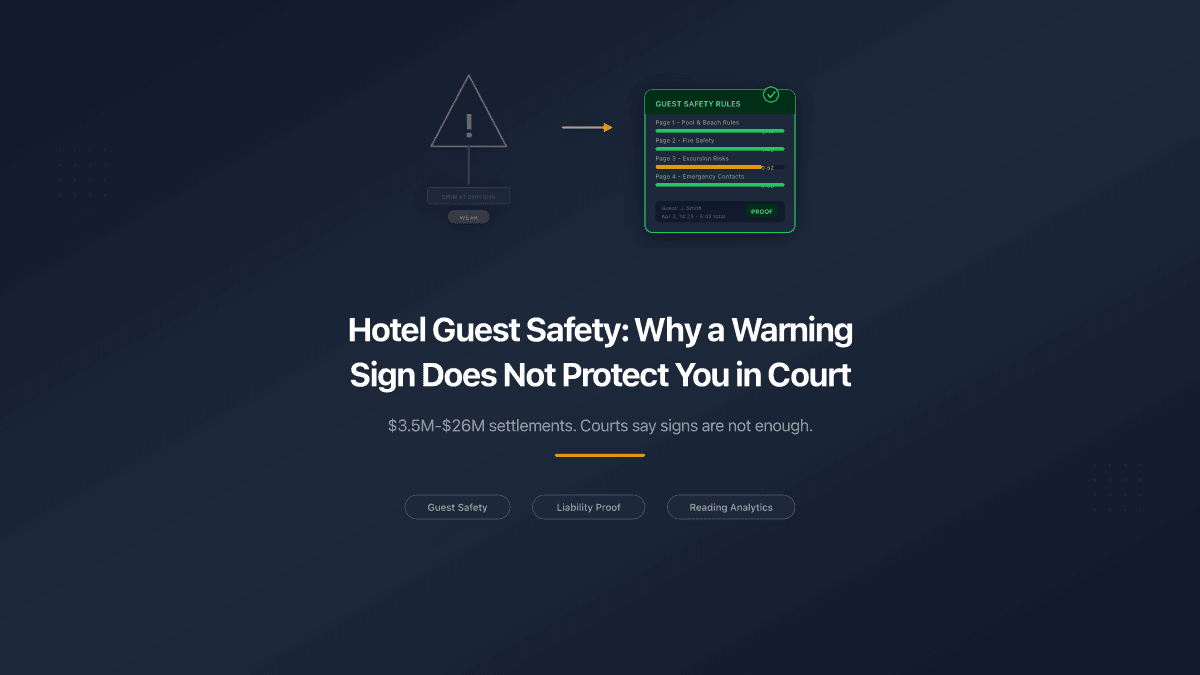
- The hotel retains a timestamped record: "Guest John Smith opened Safety Rules on April 2 at 14:23, spent 4 minutes, viewed all 6 pages including Page 3 (Swimming Pool and Beach Safety)"
Three scenarios illustrate why this changes the liability equation:
Scenario 1: Guest did not open the link. The hotel has documented proof that the safety rules were delivered to the guest's device. The guest chose not to read them. This is the digital equivalent of handing someone a document they refused to open - significantly stronger than a sign they may never have seen.
Scenario 2: Guest opened but skipped the pool safety page. The analytics show the guest read pages 1, 2, 4, 5, and 6 but skipped page 3 (pool rules). The hotel warned. The guest selectively ignored the relevant section. This granularity does not exist with any other warning method.
Scenario 3: Guest read everything. The guest spent 4 minutes reading all safety rules, including the section about swimming after dark. They went swimming after dark anyway. The hotel has the strongest possible evidence that the guest was informed and chose to disregard the rules.
In every scenario, the hotel's position is stronger than with a sign, a checkbox, or a signed waiver.
Who Benefits Most
| Role | Current Problem | With Reading Analytics |
|---|---|---|
| Hotel general manager | Cannot prove guests were warned. Relies on signs and check-in paperwork | Timestamped proof per guest. Exportable for legal defense |
| Resort risk manager | Insurance premiums rising 17-25%/year. No documented risk mitigation | Evidence of proactive safety communication. Basis for premium negotiation |
| Tour operator (TUI, Jet2) | Strictly liable for hotel safety under Package Travel Regulations | Proof that partner hotels warned guests. Reduces operator's liability exposure |
| Hotel chain compliance | Inconsistent safety communication across properties | Standardized safety document with per-property, per-guest reading data |
| Insurance underwriter | Claims increasing, premiums rising, limited visibility into hotel safety practices | Documented guest awareness as a risk factor in pricing |
The Resort and Activity Layer
Hotels with on-site activities face additional liability for each activity a guest participates in - pools, beaches, water sports, gyms, kids' clubs, excursions. Each carries its own risk profile and warning requirements.
Current practice: separate paper or digital waivers per activity. A guest at a Red Sea resort might sign waivers for the pool, the beach, the dive center, and the desert excursion - four separate documents, none of which verify reading.
With document analytics, the hotel shares a single comprehensive safety guide covering all facilities and activities. The analytics show which sections each guest read. The dive center section on pages 8-10 was read for 2 minutes. The pool section on page 3 was skipped. The beach section on page 4 was read but the guest returned to it the next day.
This replaces four unsigned-or-signed-without-reading waivers with one document that provides richer evidence about actual guest awareness.
Reading analytics do not replace physical safety measures - pool fencing, depth markers, trained lifeguards, equipment maintenance, and hazard inspections remain essential. Analytics document the communication layer: proof that the guest was informed of rules and risks. The strongest safety programs combine physical measures with documented guest awareness.
The Insurance Argument
Hotel insurance is becoming one of the fastest-growing operational expenses. CBRE reports that insurance carriers have taken a firmer stance in pricing coverage for hotels. Property insurance rates are increasing 17-26%, with high-risk or loss-heavy properties facing hikes of 50% or more.
Insurance premiums are tied to claims history and documented safety practices. Hotels that can demonstrate proactive risk communication - not just signs on walls but verified guest acknowledgement - have a basis for negotiating lower premiums. Even a 5% reduction on a $100,000 annual policy saves $5,000 - more than the cost of a document analytics subscription.
The argument to the insurer: "Every guest at our property receives safety rules on their phone at check-in. We track reading completion. 87% of guests read the full document. Here is the data for the last 12 months." That conversation is different from "we have signs posted."
From Warning to Proof
Hotels invest in physical safety: barriers, lighting, equipment, training, inspections. These measures prevent incidents. But when an incident occurs despite physical measures - because a guest chose to ignore rules - the hotel's defense depends on proving the guest was warned.
A sign on the wall says "we tried." A signed waiver says "they agreed to something." Page-level reading analytics say "this guest received our safety rules on this device at this time, spent this many minutes reading, viewed these specific pages, and either read or skipped the section relevant to the incident."
The difference between these evidence levels, in a courtroom where a $12.5 million settlement is on the table, is the difference between "we cannot prove the guest knew" and "here is exactly what the guest read."
PaperLink tracks page-by-page viewing analytics for shared documents - including time per page, completion percentage, and tab visibility detection. Hotels and resorts use it to share safety rules with guests via QR code or link at check-in, creating a timestamped reading audit trail per guest. No app required - guests read in a browser on any device. Try it free.