A ministry of health approves a new stroke treatment protocol. The document is published on the official website. Regional health authorities receive an email notification. Hospitals are expected to find the protocol, adopt it internally, and train their staff.
Six months later, a national audit reveals that fewer than half of neurological departments follow the updated procedure. The ministry cannot explain why. It cannot identify which hospitals received the protocol, which ones opened it, and which clinicians read the relevant sections. The protocol exists. The evidence of its adoption does not.
This is not a hypothetical scenario. It is the documented reality of clinical guideline distribution in health systems worldwide. Only 55% of recommended clinical measures are ultimately applied to patients. In specific clinical areas, adherence drops to single digits - 8.6% for knee osteoarthritis management in one systematic review.
The protocols are written. The evidence they reached clinicians is missing. And no ministry of health in the world has a system that answers the question: "Did Hospital X read Protocol Y?"
The Distribution Model That Does Not Work
Health ministries follow a remarkably consistent pattern across countries and continents. A clinical guideline is developed, reviewed by expert committees, approved by the minister or designated authority, and published - typically on the ministry's website, in an official gazette, or through a formal order.
After publication, responsibility shifts. Each facility is expected to locate the protocol, issue an internal adoption order, and ensure staff compliance. The ministry moves on to the next guideline.
The gap between publication and adoption is where clinical quality breaks down.
A survey of 400 physicians identified the barriers to guideline adherence: 65% cited time constraints from clinical responsibilities, 62% cited the high number of conditional recommendations, and 57% cited applicability concerns. But the most telling statistic: 87% of physicians agreed that point-of-care access to guidelines would improve their adherence. The demand for better distribution is explicit. The supply is absent.
In low-resource settings, the problem is more severe. In Ethiopia, fewer than 46% of health facilities had national family planning guidelines available for use. Providers reported having "only a copy" that frequently went missing. Some were not aware the national guideline existed. In Uganda, more than 60% of clinical guidelines developed by the government were not available at the service delivery level, despite being available at national offices.
The dissemination chain from ministry to facility breaks down because nobody monitors whether it works.
The implementation gap is not limited to developing countries. A CDC guideline awareness survey of 1,919 healthcare providers in the United States found that only 38% were aware of COVID-19 counseling guidelines seven months after publication. Among nurses, nurse practitioners, and physician assistants, awareness dropped to 23%. Providers who were aware of the guidance were 5.8 times more likely to actually implement it - confirming that the bottleneck is awareness, not willingness.
What Pandemic Response Revealed
COVID-19 exposed the fragility of top-down health communication more visibly than any previous crisis. Protocols changed rapidly - sometimes twice in a single day. Multiple authorities issued overlapping and occasionally contradictory guidance. Facilities received instructions through informal channels because formal distribution could not keep pace.
A study of 74 interviews with 14 UK healthcare workers over six months documented the breakdown. Guidelines were distributed by "cascading information top-down, most often digitally via official web-pages, emails, intranets." Five or more organizations - Public Health England, NHS England, the Health and Safety Executive, the Department of Health, individual hospital trusts - issued guidance simultaneously, often with inconsistencies. One emergency department lead observed: "If that had been uniform from the beginning... it feels like sometimes there have been different standards."
In Iran, a study across four hospitals and 32 healthcare professionals found that nursing, imaging, administrative, and laboratory systems operated independently with no centralized protocol distribution. Staff reported they "had not received training to care for critically ill COVID-19 patients."
During the 2014-2016 Ebola outbreak in West Africa, WHO itself later acknowledged that "urgent warnings either not reaching senior leaders or senior leaders not recognizing their significance" contributed to delayed response. The information existed. The confirmation that decision-makers received and read it did not.
These are not technology failures. They are visibility failures. Every ministry published guidance. No ministry could verify who read it.
Drug Safety Alerts: The 90% Override Problem
Pharmacovigilance faces its own version of the same gap. When a drug is recalled or a safety alert is issued, the regulatory authority publishes the notice. Whether the prescribing physician or dispensing pharmacist actually reads it is unknown.
The data on alert engagement is discouraging. 90-96% of clinical decision support alerts are overridden by physicians, according to AHRQ research on alert fatigue. Only 7.3% of alerts were found to be clinically appropriate in one analysis, which partly explains the override rate - but also means genuinely critical alerts are buried in noise.
For pharmacist-to-physician safety communications, the documented sign-off rate is 46.6%. Fewer than half of drug safety messages sent to prescribers are confirmed as received.
Drug recall processes operate at similar levels of uncertainty. Recall notices arrive at pharmacies via fax, certified letter, email, or notices bundled with invoices for other drugs. The same recall may arrive multiple times from multiple sources - or not arrive at all. If manufacturers can track down 50% of recalled medications, the recall is considered successful.
A 50% success rate for a drug recall is a data point that should concern every health ministry.
Alert fatigue is not solved by sending more alerts. It is solved by sending targeted alerts to the right recipients and verifying they engaged with the content. A system that tracks whether each prescriber of a recalled drug opened and read the safety notice provides both accountability and evidence that the ministry fulfilled its pharmacovigilance obligations.
The Accreditation Evidence Problem
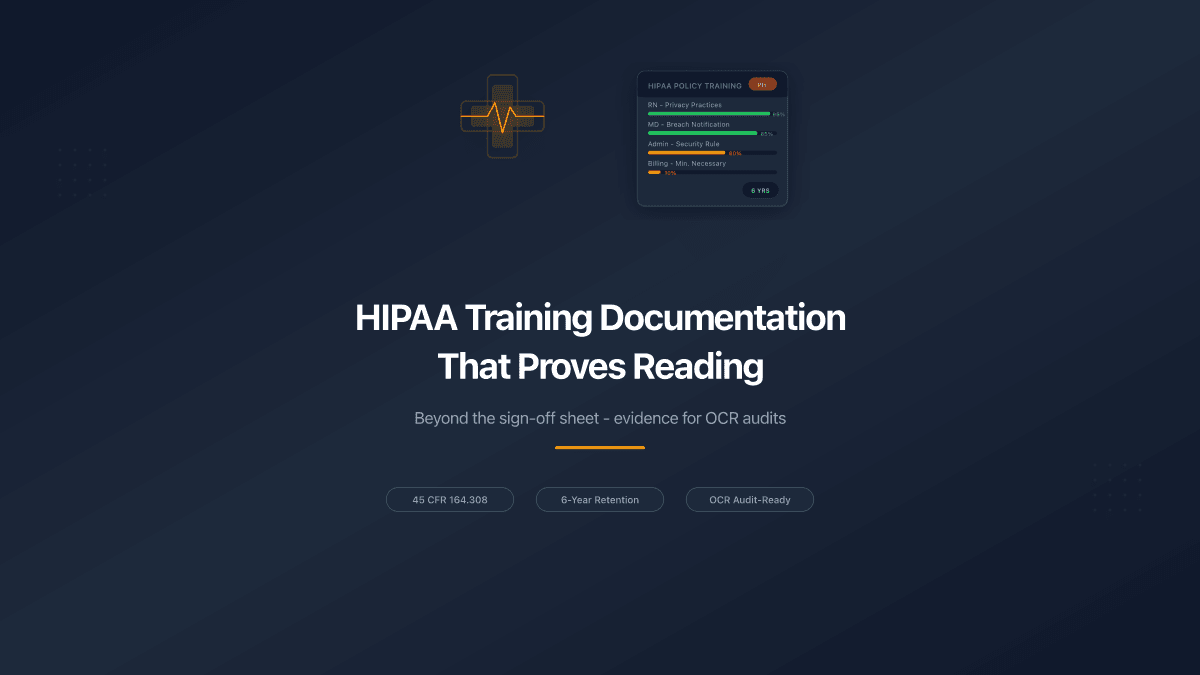
Hospital accreditation bodies - JCI, the Joint Commission, CQC - require documented proof that staff have been trained on clinical protocols. The evidence standard is clear: JCI evaluates whether policies are "not just documented but also effectively implemented" through training records, competency evaluations, and operational monitoring.
In practice, most hospitals satisfy this requirement with checkbox attestation. The numbers behind that checkbox are telling: staff spend an average of 3 seconds on a policy before clicking "acknowledge". When a quiz is assigned alongside the policy, engagement increases to 2.8 minutes. The difference between 3 seconds and 2.8 minutes is the difference between compliance theater and actual reading.
For individual hospitals, policy management tools like PolicyStat, PowerDMS, and HealthStream track internal policy attestation. But these tools serve hospitals managing their own policies. They do not solve the problem a ministry of health faces: distributing a national protocol to thousands of facilities and verifying that each one received, read, and adopted it.
No existing system gives a ministry a dashboard showing: "Protocol X was read by 78% of target facilities. Here are the 22% that have not opened it."
What Ministries of Health Actually Need
The requirements are specific and distinct from what individual hospitals need:
| Capability | Hospital-Level Tools | Ministry-Level Need |
|---|---|---|
| Distribution scope | Internal staff within one facility | Thousands of facilities nationwide |
| Document types | Internal SOPs, HR policies | National clinical protocols, drug safety alerts, emergency directives |
| Tracking granularity | Employee-level attestation | Facility-level and clinician-level reading confirmation |
| Urgency model | Scheduled policy reviews | Emergency protocols requiring rapid confirmation |
| Compliance reporting | Internal audit reports | National compliance dashboards, accreditation evidence, WHO reporting |
| Version control | Policy updates within one system | Protocol versions across independent facilities with different IT systems |
The ministry needs to answer six questions that no current system addresses:
- Which facilities have received the new protocol?
- Which facilities have opened and read it?
- How thoroughly was it read - was every page viewed, or only the summary?
- Which facilities have not yet opened the document?
- When the protocol is updated, which facilities read the new version versus the old?
- During an emergency, how quickly are facilities reading the directive?
Reading Analytics as Health System Infrastructure
Page-level document analytics - the same technology that tracks whether an investor reads a pitch deck or an employee reads a security policy - can answer all six questions.
The mechanism is straightforward:
- The ministry uploads the clinical protocol to a document sharing platform with built-in reading analytics
- Tracked links are generated per facility, per region, or per clinical specialty
- Links are distributed through existing channels - email, the ministry portal, messaging systems
- Recipients at each facility open the link and read in a browser-based viewer on any device. No software installation, no account creation required
- The analytics engine records every viewing session: pages viewed, time per page, completion percentage, return visits, tab visibility
- The ministry accesses a national compliance dashboard showing facility-level reading status in real time
For emergency protocols, this transforms distribution from "we published it" to "312 of 400 emergency departments confirmed reading within 6 hours. Here are the 88 that have not opened the document."
For drug safety alerts, the pharmacovigilance authority sees exactly which pharmacy departments have read the recall notice - and which need a phone call.
For accreditation preparation, the ministry can produce evidence that a specific protocol reached a specific percentage of facilities, with per-facility reading data that satisfies JCI and WHO reporting requirements.
| Scenario | Current Approach | With Reading Analytics |
|---|---|---|
| New clinical protocol | Published on website, no tracking | 78% of target departments read within 2 weeks, 22% flagged for follow-up |
| Drug safety alert | Published on regulator website, no confirmation | 340 of 500 pharmacies confirmed reading within 24 hours |
| Emergency directive | Emailed to regional authorities, cascaded informally | Real-time dashboard: facility-level reading status updated every minute |
| Post-incident protocol update | Re-published, no version tracking | Version-specific data: who read the old protocol vs. the updated one |
| Accreditation audit | Self-reported compliance | Per-facility reading reports with timestamps, page-level engagement data |
Reading analytics do not replace clinical training, simulation exercises, or competency assessments. They document the reference material component - proof that clinicians accessed and read the protocols that govern their practice. The strongest training programs combine classroom instruction, practical exercises, and documented reading of written protocols. Analytics provide the evidence layer that connects distribution to engagement.
The Scale of the Opportunity
The healthcare compliance software market is valued at $3.80 billion in 2025 and is projected to reach $13.18 billion by 2035, growing at 13.24% CAGR. This growth is driven by increasing regulatory requirements, the shift from point-in-time compliance to continuous monitoring, and the recognition that checkbox attestation does not satisfy modern evidence standards.
The WHO's International Health Regulations (2005), legally binding on 196 countries, establish reporting requirements that depend on health ministries having functioning communication channels to their facilities. Ten years after implementation, researchers expressed "deepening concern that the IHR have failed to fulfill the promises of sound governance". Part of that failure is communication infrastructure: a ministry cannot fulfill governance promises when it cannot verify that its directives reached the facilities responsible for implementing them.
The 70 million health workers worldwide represent the largest professional workforce that operates without a standardized system for confirming receipt and reading of the protocols that govern their practice.
From Publishing to Verifying
Health ministries have invested decades in improving the quality of clinical guidelines. Evidence-based medicine, systematic reviews, expert consensus panels, rigorous approval processes - the guideline development infrastructure is mature. The distribution infrastructure is not.
The minister signs the order. The protocol is published. The website is updated. And after that, silence. No confirmation. No reading data. No compliance evidence. The ministry assumes the protocol reached clinicians. The clinicians assume the protocol is somewhere on the ministry website. The patient assumes both parties are working from the same information.
That assumption gap - between "published" and "read" - is where clinical quality disappears. Closing it does not require restructuring the health system. It requires giving the ministry something it has never had: visibility into whether its own directives are being read.
PaperLink tracks page-by-page viewing analytics for shared documents - including time per page, completion percentage, and tab visibility detection. Health organizations use it to distribute clinical protocols, policy documents, and training materials with a complete reading audit trail per recipient. No software installation required - recipients read in a browser on any device. Try it free.