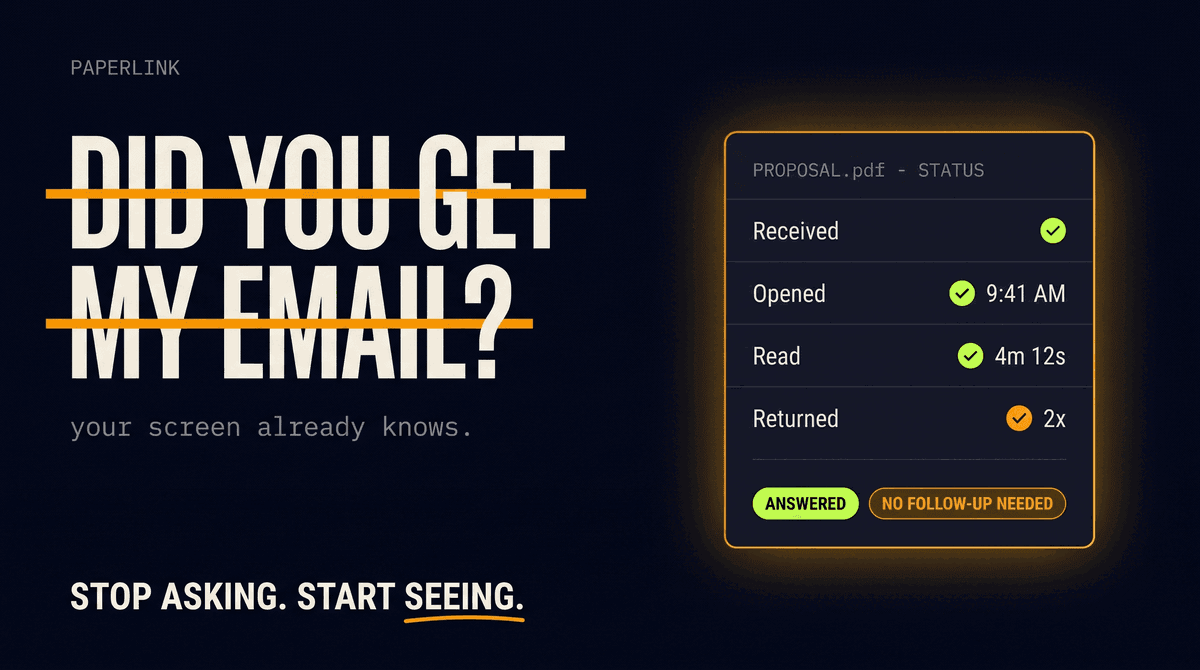
"Did you get my email?" is one of the most common sentences in business, and one of the most quietly absurd. You sent something important - a proposal, a contract, a report - and then you have to ask whether it arrived and whether anyone looked at it. The act of communicating ends in uncertainty, and the only tool to resolve it is a second, slightly anxious message.
We treat this as normal. It is not normal so much as inherited. For most of the history of business documents, the sender had no way to know what happened after sending. The file left, and silence followed. Asking became the workaround for a missing instrument.
That instrument now exists, and it is becoming ordinary. The question is on its way out, and the shift looks a lot like one the marketing world went through a generation ago.
Marketing Already Lived This
Twenty years ago, sending a marketing email was sending into the dark. You wrote it, you sent it, and you waited to see if anyone bought something. Whether the email was opened, by whom, and how many times was unknowable.
Then the tracking pixel arrived: a tiny invisible image that loads from a server when the message is opened, which is how most modern email tracking works (Mailfloss). Open rates became a number every marketer watches. Within a few years, running an email campaign without knowing the open rate went from impossible to unthinkable. Nobody argued the philosophy of it. The visibility was simply better, so it won.
That history matters because the same transition is now happening one layer over, with the documents that move between businesses rather than the emails that carry them.
The Document Caught Up to the Email
Email marketing got analytics. The attached document never did. You could see that your campaign email was opened, but the PDF inside it remained a black box - downloaded or not, read or not, forwarded or not, you had no idea.
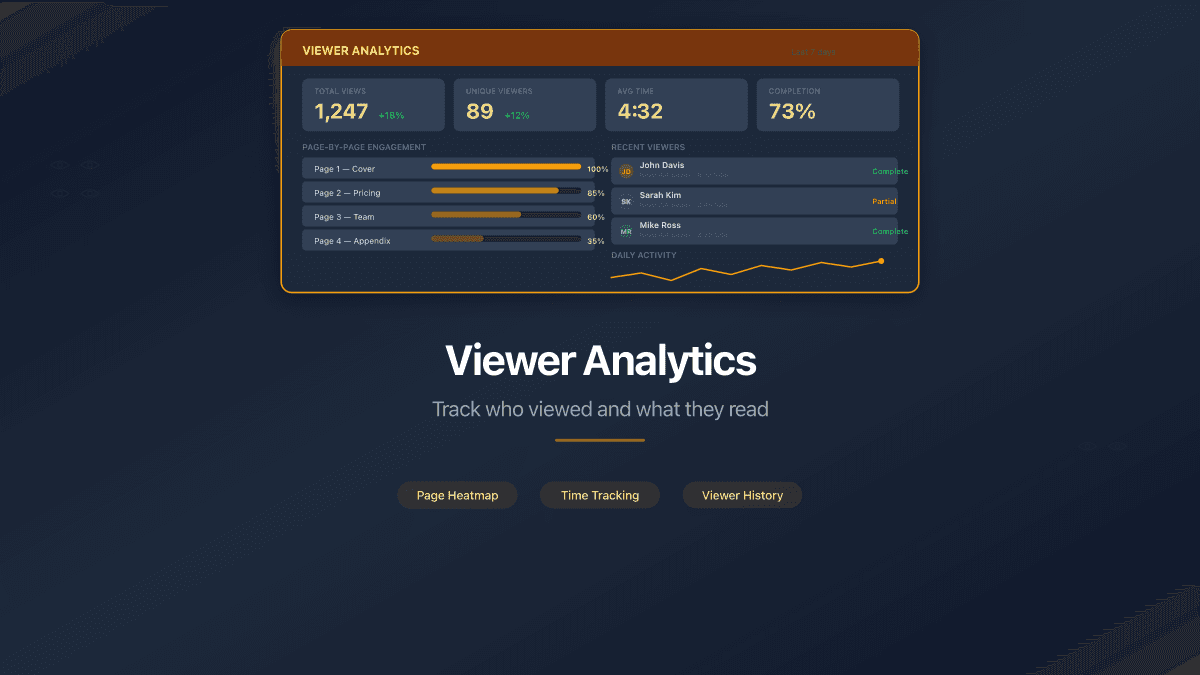
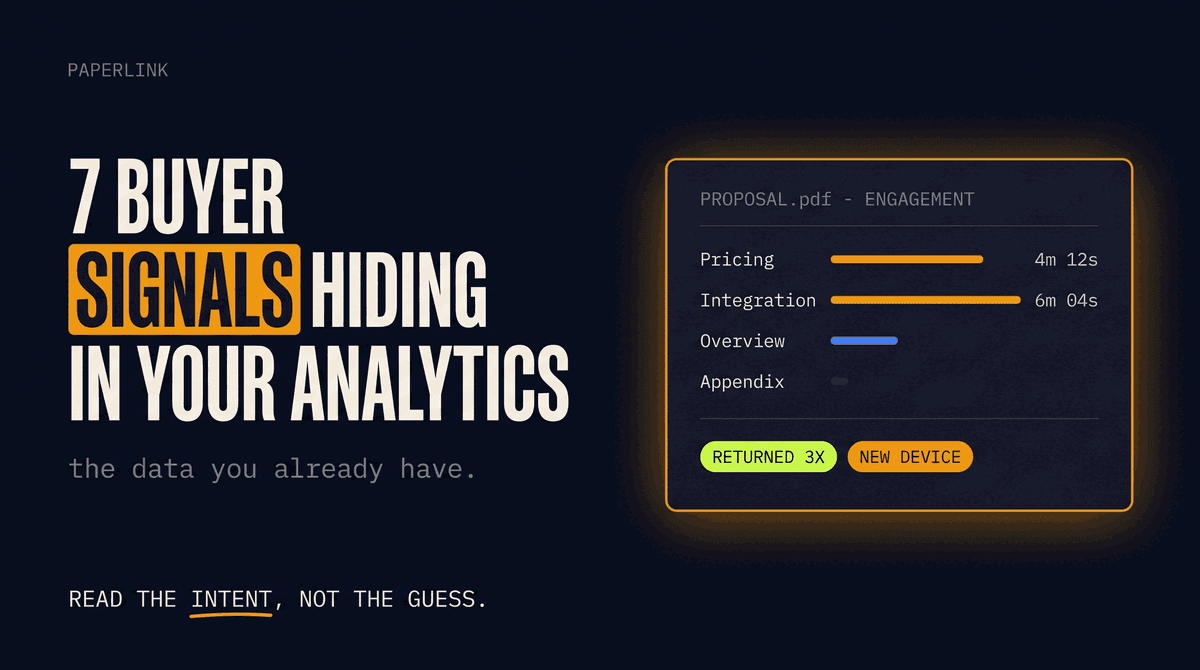
That gap is closing. When a document is shared as a tracked link instead of an attachment, it carries its own analytics: when it was opened, how long each page held attention, whether the viewer returned, whether it spread to someone new. The file stops being a dead object that leaves your control and becomes a live one that reports back.
The effect on the sender is the same one marketers felt in the 2000s. The anxious follow-up disappears because the question it was asking has already been answered. You do not ask "did you get my proposal?" when your screen already shows that the recipient read it twice yesterday and spent four minutes on the pricing page.
A shared document with analytics answers the questions a follow-up email used to ask: was it received, was it opened, was it read, and which parts mattered. See Track Who Viewed Your Shared Documents for what that looks like in practice.
What This Changes About How We Work
The end of the blind send is not only a convenience. It changes the texture of business communication in a few specific ways.
Follow-ups stop being scheduled and start being triggered. Instead of "wait three days, then nudge," you reach out when the document shows real engagement. The cadence follows behavior, not a calendar.
Silence becomes legible. An unopened document and an opened-but-ignored one used to look identical - both produced no reply. Now they are different events with different meanings, and you respond to each differently.
And the document itself becomes a feedback instrument. If every reader stops on the same page, that page has a problem. The thing you sent to inform someone also informs you, in a way a static attachment never could.
The Honest Caveat
This is not a frictionless utopia, and pretending otherwise would repeat marketing's mistakes. Email open tracking became so pervasive that it provoked a backlash; Apple's Mail Privacy Protection, which loads tracking pixels indiscriminately to break open-rate data, is one of the largest anti-tracking deployments in email history (Mailfloss). Visibility and privacy pull against each other, and the document world will have to navigate the same tension.
The answer is not to track less but to track honestly: with the recipient's awareness where it matters, with controls that protect sensitive content, and without pretending analytics prove more than they do. Knowing someone opened a contract is not the same as knowing they agreed to it. The instrument is powerful precisely because it is narrow, and overclaiming is how good tools earn bad reputations.
A Question That Will Sound Strange
A few years from now, "did you get my document?" will sound the way "what was our email open rate?" would have sounded to a marketer in 1999 - a question you should not have to ask, because the system already tells you. The uncertainty that defined business communication for decades is becoming optional, and optional uncertainty does not survive long once a better default exists.
The blind send had a long run. It is ending, not with an argument, but the same way the blind email campaign ended: quietly, because seeing is better than guessing.
Send your next document as a tracked link. For where this trend is heading across the industry, see What Is Document Analytics?.